Accueil Blog

MITRE ESTM + EMB3D in Action : Analyzing OPS-SAT Through These Dual Frameworks

0

Disclaimer

Please be informed that the analysis detailed in this article is entirely separate from the hacking experiment conducted by the Thales team on the satellite.

Both activities are independent of each other and were carried out by different teams. There is no association between me and the team that conducted the hacking experiment.

This work is conducted on a personal basis and is independent of my work at Thales. Thales is in no way involved in this work, and Thales’s responsibilities cannot be engaged under any circumstances.

All slides embedded in this article are public slides presented by Thales during the CYSAT 2023 conference and available in the Youtube video which presents the Thales experiment.

Purpose of the article

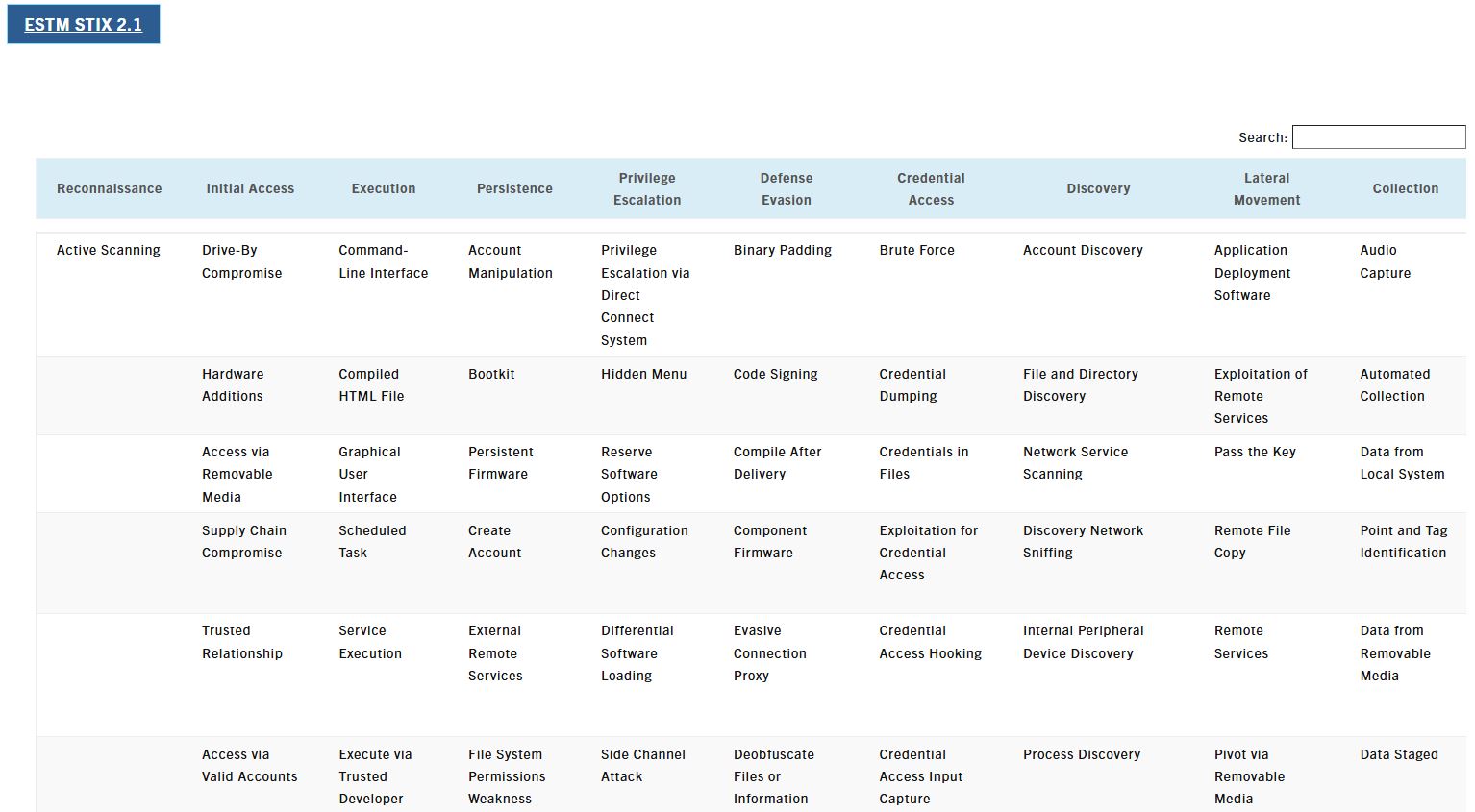
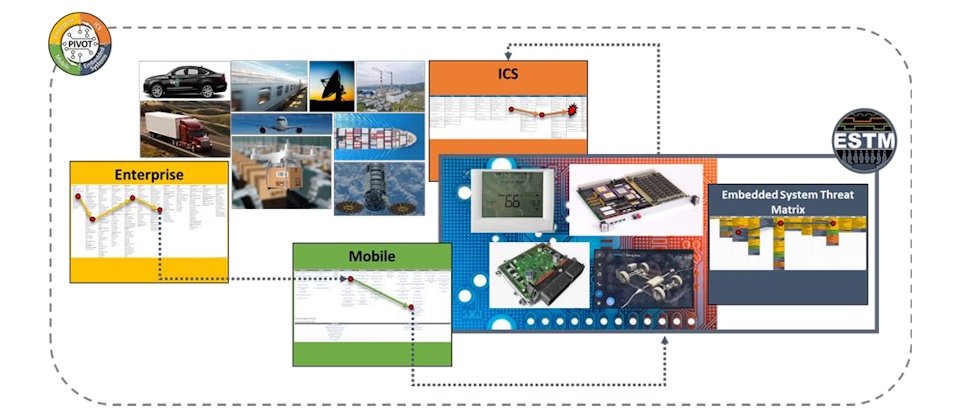
Recently, MITRE released the Embedded Systems Threat Matrix (ESTM), a new ATT&CK-style cybersecurity framework tailored to protect embedded systems through adversary tactics, techniques, and procedures (TTPs).

In a previous analysis, I applied the MITRE EMB3D™ Threat Model to dissect the Thales satellite hacking demonstration from CYSAT 2023, identifying key vulnerabilities and countermeasures across OPS-SAT’s attack chain.

This article replicates the study but using ESTM, mapping EMB3D Threat IDs to ESTM TTPs to demonstrate their practical complementarity.

The result showcases how these frameworks complement each other, EMB3D for secure-by-design threat modeling, ESTM for offensive kill-chain analysis, enabling comprehensive defense for space and embedded systems.

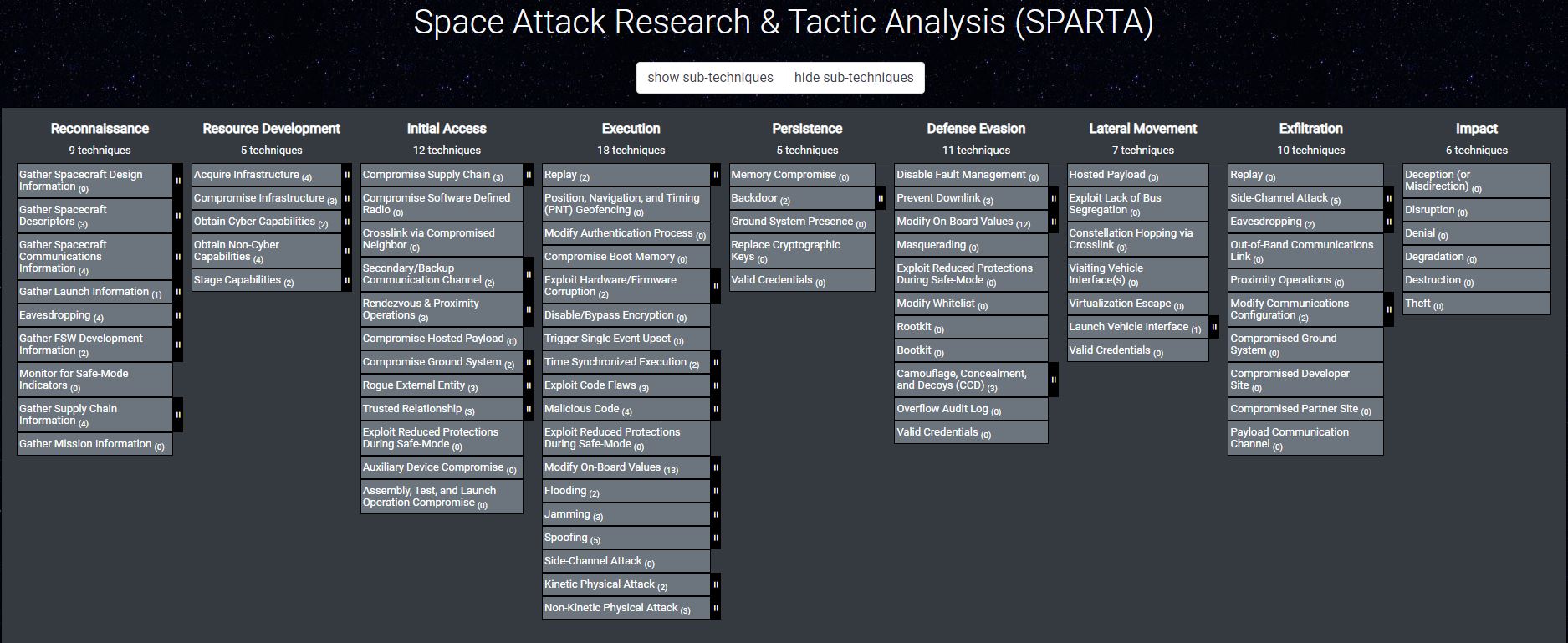
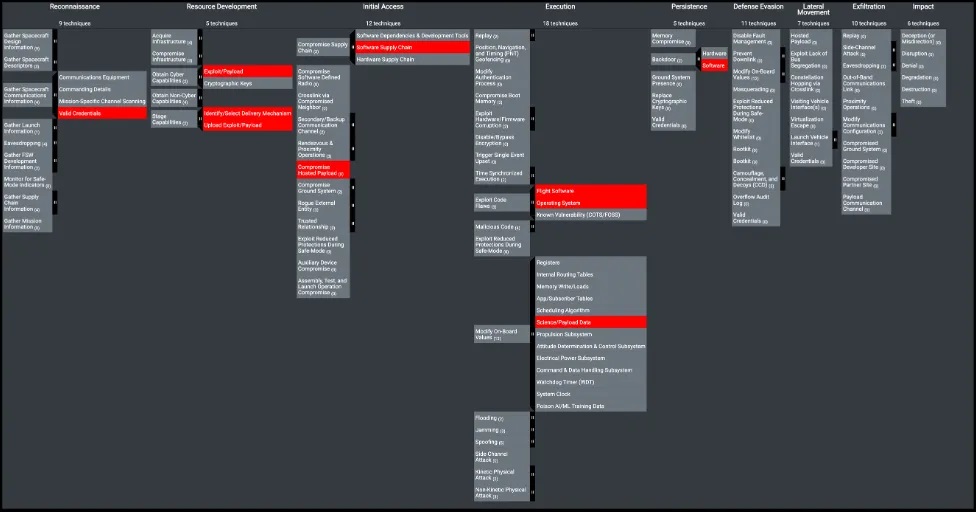
I also take this opportunity to highlight the TTPs identified by Brandon Bailey & Brad Roeher from the SPARTA team, who used the SPARTA framework to deconstruct the experiment.

More about the Thales hacking demo at CYSAT 2023 on the OPS-SAT satellite

To know more about the Thales hacking demo at CYSAT 2023, I encourage you to visit the following pages herehere and here where the results of the ethical satellite hacking exercise is detailed.

To know more about the Thales hacking demo at CYSAT 2023, I encourage you to visit the following page here where OPS-SAT, a small, CubeSat-class satellite developed by the European Space Agency (ESA) to serve as a testbed for innovative software, systems, and operational concepts in space, is detailed.

More about EMB3D and ESTM

Methodology

To bridge EMB3D and ESTM, I followed a structured mapping process across the five-step OPS-SAT attack chain documented in my prior EMB3D analysis. For each step, I identified relevant EMB3D Threat IDs (TIDs) based on device properties and vulnerabilities exploited by Thales.

These TIDs were then mapped to ESTM’s tactics (e.g., Initial Access, Persistence) and embedded-specific techniques (e.g., Firmware Injection, Bus Interception), drawing from ESTM’s ATT&CK-inspired structure tailored to hardware/firmware realities.

This bidirectional approach validates EMB3D mitigations against realistic adversary TTPs while highlighting ESTM gaps for space systems like OPS-SAT.

OPS-SAT Attack Chain Mapping

Now let’s apply this methodology to the Thales OPS-SAT demo, breaking down each of the five attack steps with their corresponding EMB3D TIDs and ESTM TTP mappings.

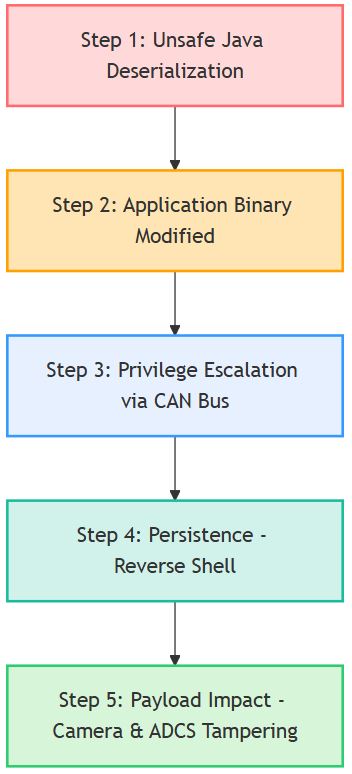
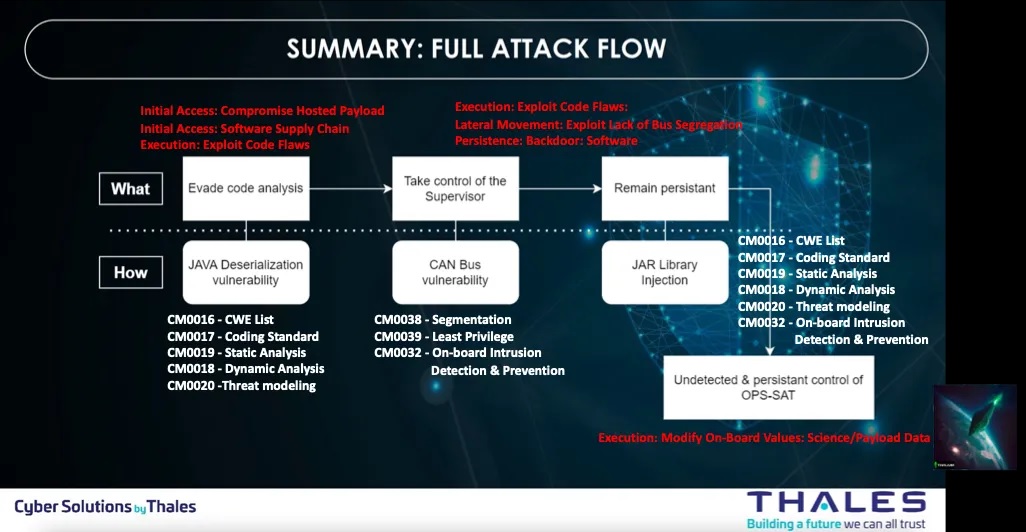
The figure below is showing a summary of the full attack flow used by the Thales team to conduct the attack on OPS-SAT.
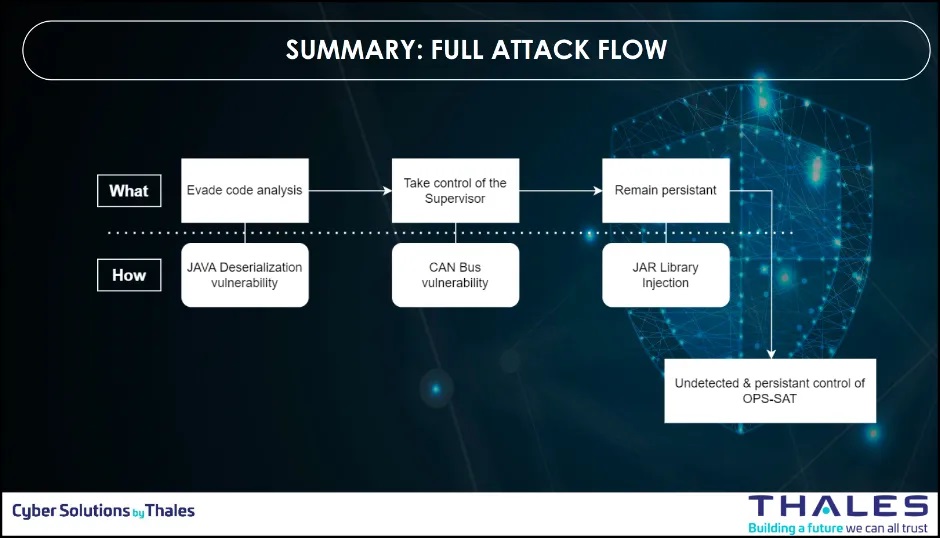
Figure 1: Summary of the full attack flow (Slide courtesy Thales Group)

Step 1: Unsafe Java Deserialization

To introduce the compromised or flawed software onto the spacecraft, the team needed to bypass security checks and evaluations. To achieve their objective, they introduced a deserialization vulnerability into the software, enabling defensive mechanism evasion and potential exploitation for executing arbitrary commands.
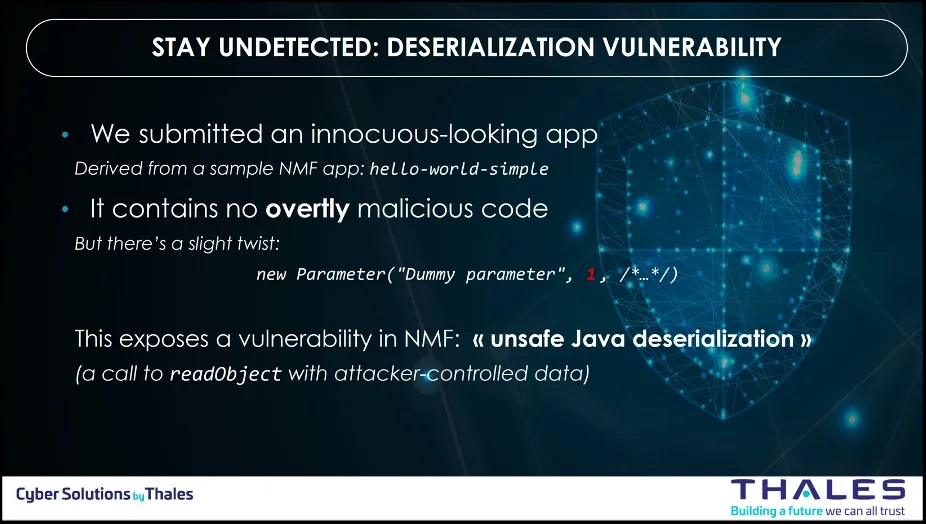
Figure 2: The Deserialization Vulnerability (Slide courtesy Thales Group)
EMB3D Threat ID SPARTA TTPs ESTM TTPs
  • EST000131: Application Deployment Software
  • EST000134: Remote File Copy
  • EST000160: Program Upload

Others proposed ESTM TTPs for step 1 :

As the ground segment use a ground proxy to connect to the space segment, I propose to add the following ESTM TTPs

  • EST000021: Execute via Trusted Developer Utilities
  • EST000073: Evasive Connection Proxy
  • EST000094: Evade via Trusted Developer Utilities
  • EST000167: C2 Connection Proxy
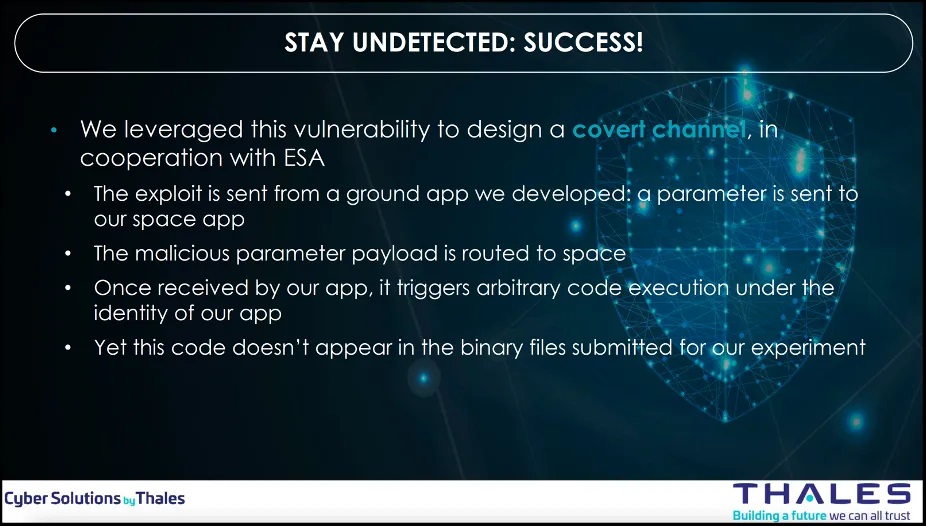
Figure 3: Stay Undetected – Success! (Slide courtesy Thales Group)

Step 2: Applications Binaries Modified 

Once the insecure deserialization achieved, the team uploaded a malicious code with the deserialization vulnerability to modify the application-level binaries on the remote device to introduce unauthorized code and to execute arbitrary commands on the remote system.
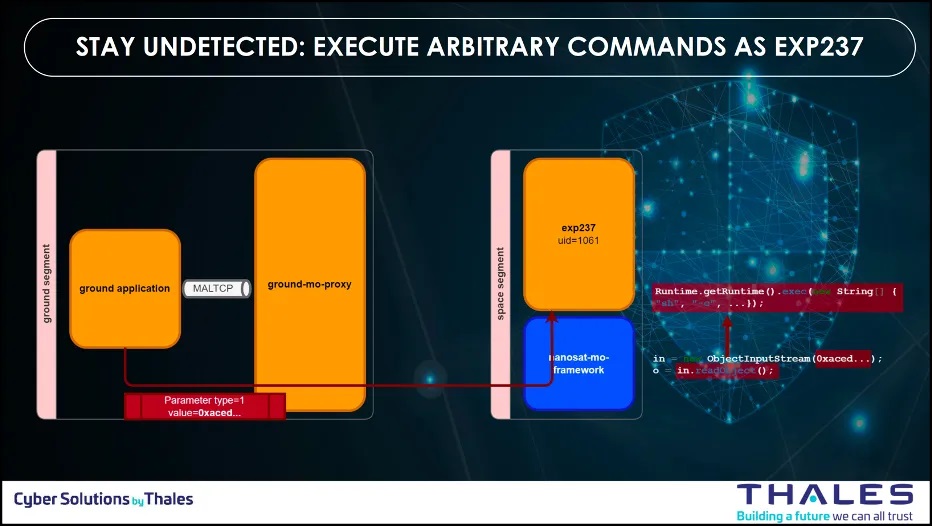
Figure 4: Stay Undetected – Execute Arbitrary Commands (Slide courtesy Thales Group)
EMB3D Threat ID SPARTA TTPs ESTM TTPs
  • EST000089: Process Injection
  • EST000020: Service Execution
  • EST000036: Persistent Firmware
  • EST000210: Malicious Firmware Implant

Step 3: Privilege Escalation via CAN Bus

At this stage, their app runs as an unprivileged Linux user and has no direct access to sensors but though the supervisor. Their objective is now to find system configuration issues or vulnerabilities to realize a privilege escalation from user to root.

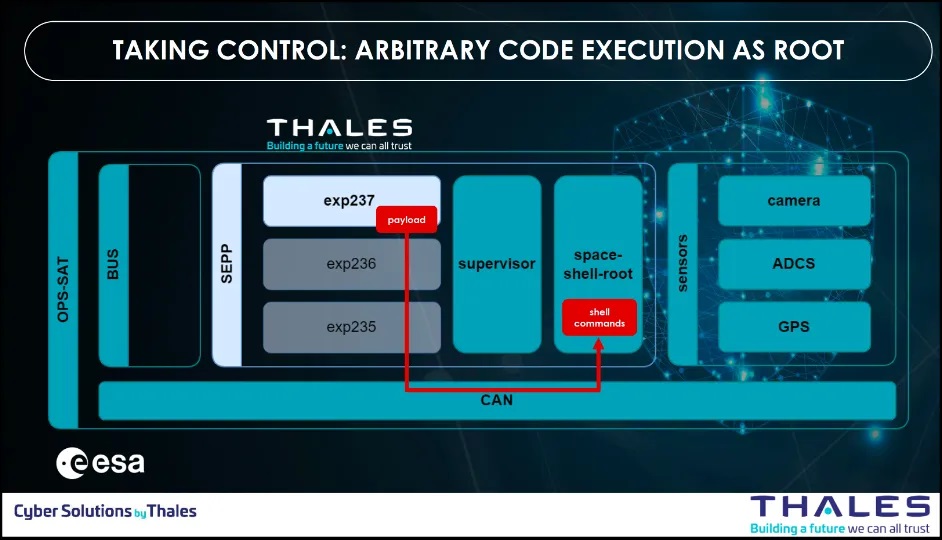
They identified that anyone can talk on the CAN bus, including unprivileged apps. And then, all commands send on the CAN bus are executing as root by a client that runs as root and that decodes and executes as root whatever command it receives.
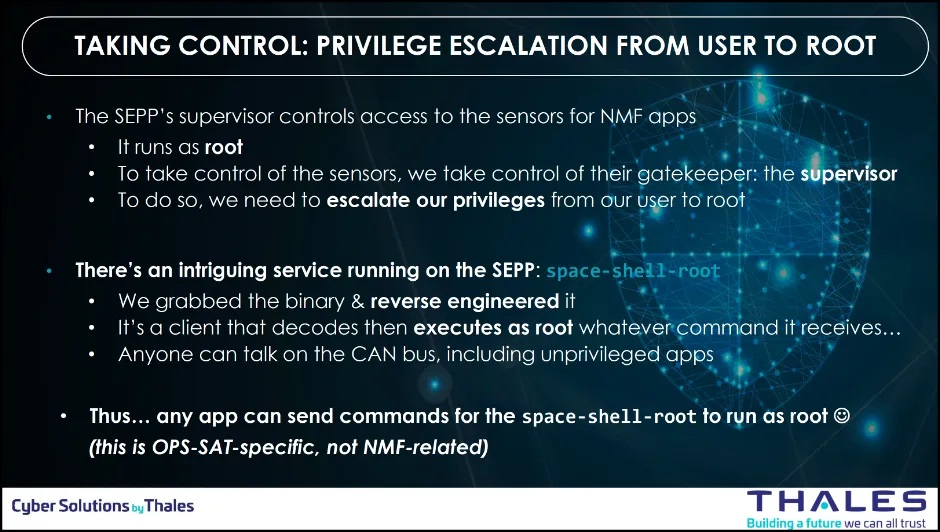
Figure 5: Taking Control – Privilege Escalation from User to Root (Slide courtesy Thales Group)
EMB3D Threat ID SPARTA TTPs ESTM TTPs
  • EST000006: Access via Valid Accounts
  • EST000047: Path Interception
  • EST000062: Privilege Escalation via Direct Connect System
  • EST000085: Bus Communication Masquerading
Figure 6: Taking Control – Arbitrary Code Execution as Root (Slide courtesy Thales Group)

Step 4: Persistence

At this stage, the app escalated as root. Now, the team needed to ensure persistent effects on sensors. They identified a jar library on the Supervisor that is writable by root user. A jar is simply a zip file, with compiled Java bytecode inside. The team crafted a bytecode based on the original one, and simply replace some files inside the jar. The supervisor now runs the jar containing the malicious bytecode.
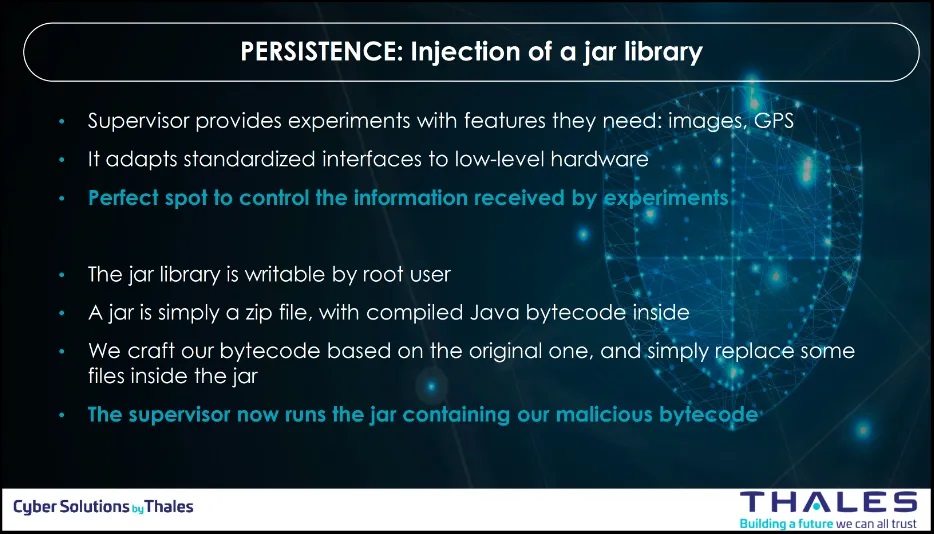
Figure 7: Persistence – Injection of a Jar Library (Slide courtesy Thales Group)
EMB3D Threat ID SPARTA TTPs ESTM TTPs
  • EST000039: File System Permissions Weakness
  • EST000041: Persistence Hooking
  • EST000054: Persistence via Valid Accounts
  • EST000061: Operational Data Files
  • EST000084: Process Masquerading

Step 5: OPS-SAT attack by tampering with camera and ADCS 

Once the team escalated as root and ensured persistency, they took control on the supervisor and the demo effects was achieved.
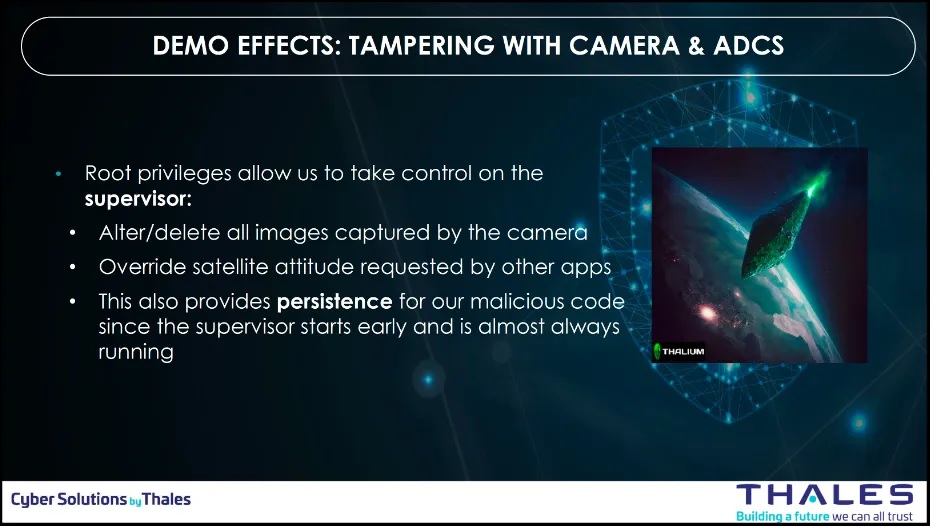
Figure 8: Demo Effects – Tampering with Camera & ADCS (Slide courtesy Thales Group)
EMB3D Implied Threats SPARTA TTPs ESTM TTPs
Sensor/Actuator Tampering
  • EST000145: Audio Capture
  • EST000153: Video Capture
  • EST000155: Capture Camera
  • EST000165: Intercept Sensor Data Prior to Processing
  • EST000193: Data Manipulation

Step 6: Other potential effects (but non demonstrated)

When adversaries target a spacecraft, their primary goal is often to disrupt the mission. This disruption can involve compromising imagery, intercepting signals, or other mission-critical functions. Thales Group demonstrated this by successfully manipulating the payload data transmitted from the spacecraft. They also identified additional potential impacts that could occur if attackers gain further access and maintain their presence, though these were not carried out. With root access and ongoing control, the range of possible attacks becomes virtually unlimited.

  • They could alter/delete all images captured by the camera
  • They could override satellite attitude requested by other apps
  • This also provides persistence for the malicious code since the supervisor starts early and is almost always running
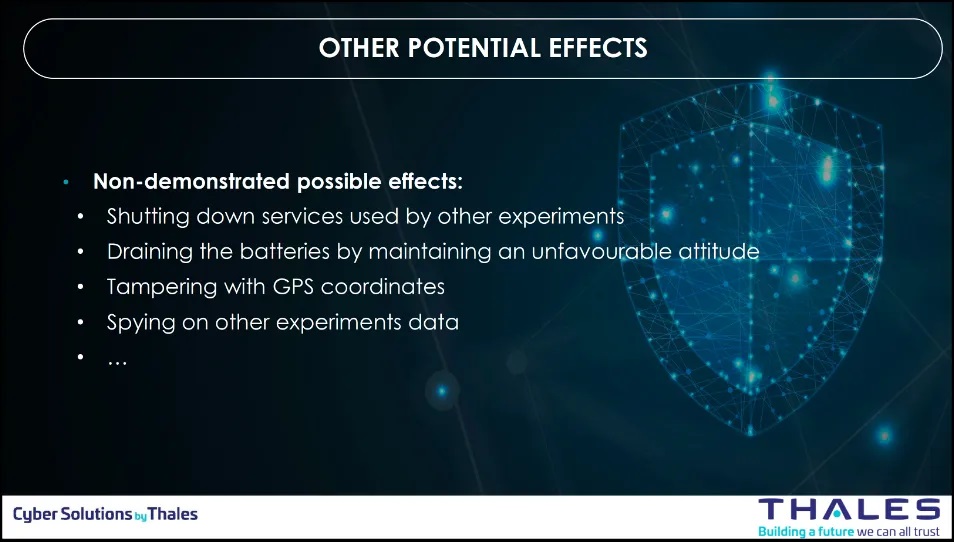
Figure 9: Other Potential Effects (Slide courtesy Thales Group)

Observations

Complementarity: EMB3D and ESTM are genuinely complementary

  • EMB3D models threats from device properties (hardware, firmware, software, comms, safety features) → threats → mitigations (secure-by-design focus).
  • ESTM captures adversary TTPs across the full embedded attack chain (recon, initial access, firmware manipulation, bus abuse, impact) in ATT&CK-style matrix format.

Mapping Reality: Not all EMB3D TIDs have a direct equivalent to ESTM techniques:

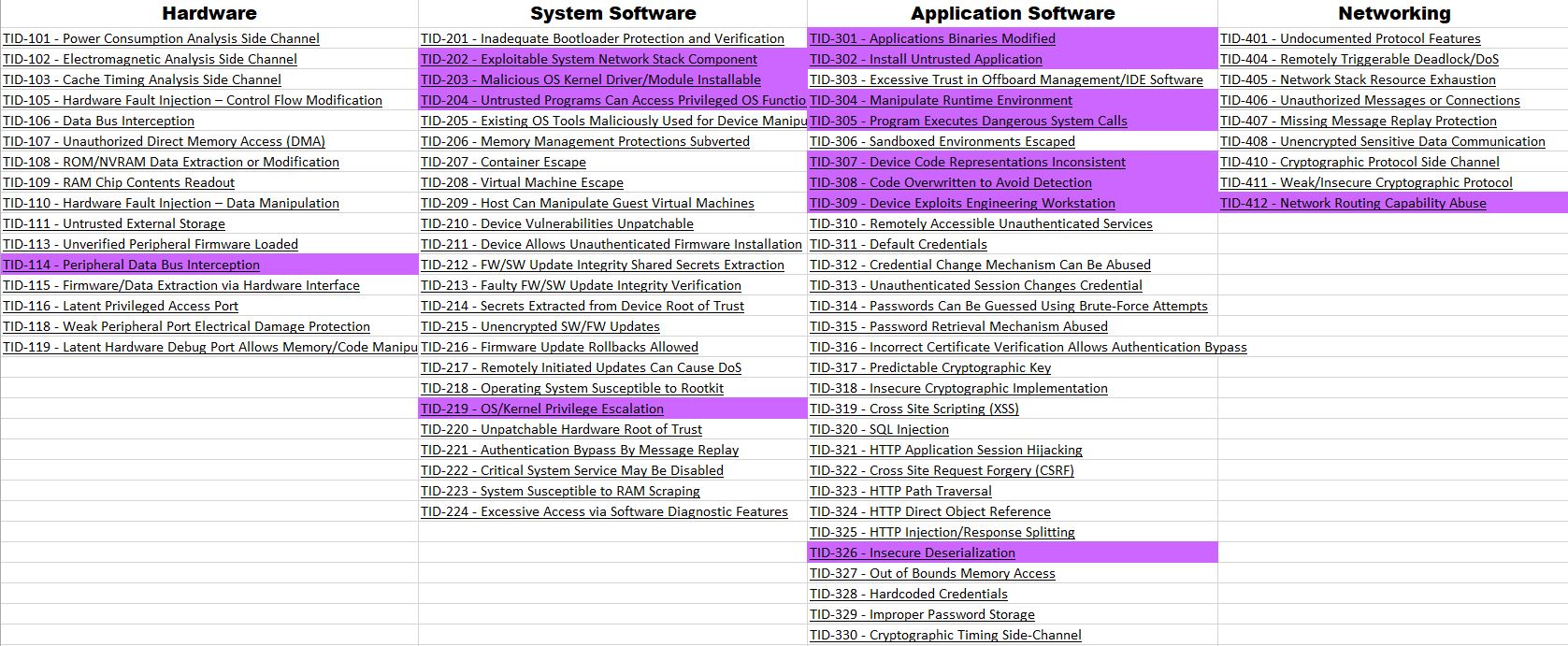
  • Good coverage: TID-326 (unsafe deserialization), TID-301/302 (binary mods), TID-114 (bus interception) → clear ESTM Initial Access/Persistence/Lateral Movement equivalents.
  • Software gaps: Pure software exploits (TID-305 dangerous syscalls, TID-204 untrusted program access) fall in ESTM’s « Execution/Privilege Escalation » but lack embedded-specific granularity vs. enterprise ATT&CK.
  • Hardware strength: ESTM shines on bus interception (CAN/SpaceWire), firmware persistence, boot tampering → areas where EMB3D stays higher-level.

Practical Takeaway

Use EMB3D first for architecture review (derive requirements/mitigations), then ESTM to validate those mitigations block realistic embedded TTPs. The OPS-SAT case proves this works across space systems.

Conclusion

Practical Complementarity Proven

The OPS-SAT attack chain mapping confirms EMB3D and ESTM work powerfully together: EMB3D identifies threats from device properties (hardware → software → mitigations), while ESTM captures adversary TTPs across the embedded kill chain (firmware exploits, bus abuse, persistence).

Mapping Insights

  • Strong alignment: Bus interception (TID-114), binary modification (TID-301/302), kernel persistence (TID-203) map cleanly to ESTM’s hardware/firmware tactics.
  • Software gaps: Pure software exploits (TID-326 deserialization, TID-305 syscalls) find equivalents in ESTM’s Execution/Privilege Escalation tactics but lack the embedded-specific granularity of hardware-focused techniques.

Actionable Workflow

  1. EMB3D first: Model device properties → derive mitigations during design.
  2. ESTM validation: Test those mitigations against realistic embedded TTPs.
  3. Iterate: Use gaps to prioritize R&D (software TTPs need more embedded detail).

Space Systems Impact

For satellite or space programs, this dual-framework approach delivers comprehensive threat coverage from architecture to operations, bridging the secure-by-design and red-team worlds.

Future work

Enhanced Risk Mitigation with ESTM Mitigations

Future iterations of this analysis will leverage upcoming ESTM versions featuring Associated Mitigations, similar to ATT&CK’s mitigation guidance. This will enable direct mapping from ESTM TTPs to specific countermeasures (e.g., secure boot enforcement, CAN bus encryption, …).

Operational Impact

This will deliver satellite programs a prioritized mitigation backlog, from Foundational (e.g., disable debug ports) to Leading Edge (e.g., runtime integrity monitoring), directly tied to demonstrated attack chains like Thales’ CYSAT demo.

The combined ESTM+EMB3D methodology positions space cybersecurity as proactive engineering, not reactive forensics. Stay tuned for the mitigations deep-dive!

Adding SPARTA to have a complete Space Framework

SPARTA from The Aerospace Corporation rounds out the perfect space cybersecurity stack. SPARTA (Space Attack Research & Tactic Analysis) is the space-mission-specific ATT&CK matrix, tactics/techniques/procedures (TTPs) for spacecraft across ground, link, and orbit phases. ESTM + EMB3D + SPARTA can offer a full framework for satellites/space systems
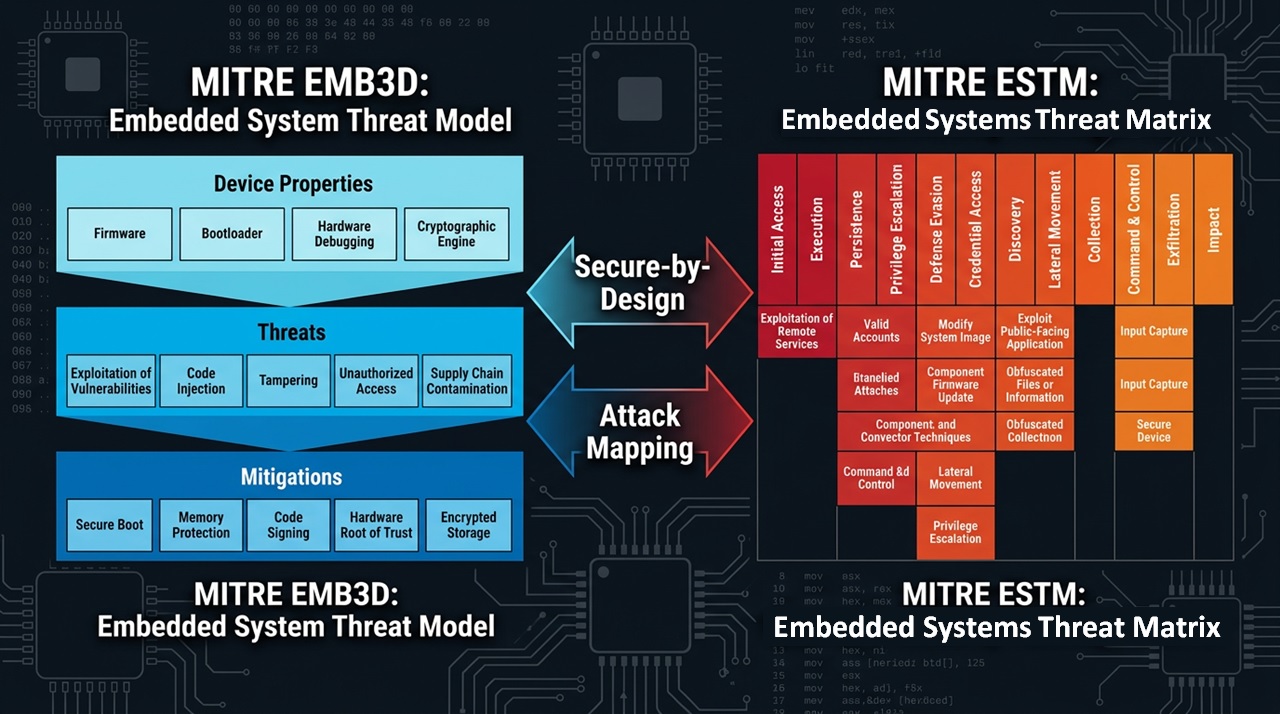
Exploring how the new MITRE ESTM (Embedded Systems Threat Matrix) can work in conjunction with the existing MITRE EMB3D Threat Model

0

Recently, MITRE released ESTM (Embedded Systems Threat Matrix), a new cybersecurity framework designed to protect embedded systems. Built on the proven ATT&CK® methodology, ESTM organizes tactics and techniques (TTPs) tailored to embedded environments.

In parallel, MITRE launched EMB3D in 2024, a threat model focused on secure-by-design embedded devices, while ESTM takes an offensive approach as an attack matrix.

This article explores how ESTM and EMB3D can work together for comprehensive embedded system defense.

ESTM and EMB3D

ESTM and EMB3D are designed to be complementary: you can use EMB3D to drive secure‑by‑design requirements and mitigations at device level, and ESTM to map real attacker behaviors and operations against those devices throughout their lifecycle.

Mental model: what each brings

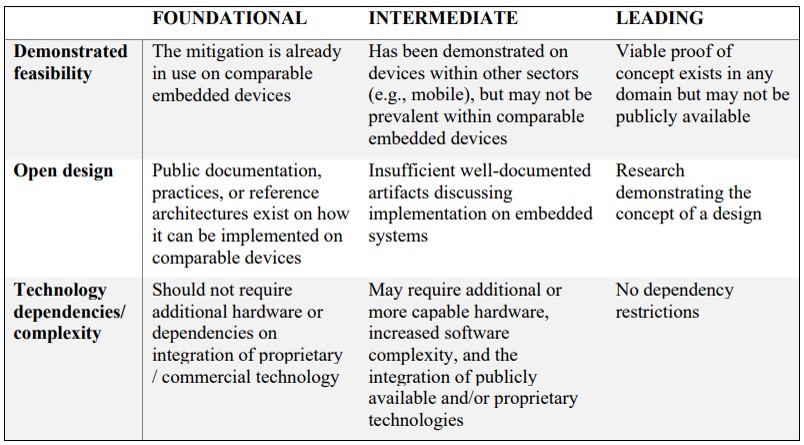
  • EMB3D is a curated threat model for embedded devices that maps device properties to known threats and prescribes tiered mitigations (Foundational/Intermediate/Leading). We explore more in depth MITRE EMB3D in this article.
  • ESTM is an ATT&CK‑style matrix of tactics and techniques tailored to embedded systems, focused on how adversaries actually operate (kill‑chain perspective). We explore more in depth MITRE ESTM in this article.
  • MITRE explicitly states ESTM “works with” EMB3D to provide a complete resource for secure system design and defense.

Typical workflow: EMB3D → ESTM → EMB3D

1. Architecture & design (EMB3D first)

  • Use EMB3D Properties to model your device (boot architecture, debug interfaces, comms stacks, safety features, etc.).
  • From those Properties, enumerate relevant Threats and associated Mitigations, and derive security requirements (e.g. “protect firmware update mechanism”, “harden debug ports”).

2. Adversary behavior mapping (ESTM)

  • For each EMB3D Threat, identify which ESTM tactics/techniques an attacker would likely use (e.g. Initial Access via supply‑chain, Firmware Persistence via malicious bootloader, Lateral Movement over fieldbus).
  • Use this to define detection use‑cases, test scenarios, and red‑team playbooks that are realistic for embedded environments (not generic IT ATT&CK).

3. Refine mitigations and coverage (back to EMB3D)

  • Take the ESTM techniques you care about most (based on threat intel, safety impact, mission impact) and check whether EMB3D’s mitigations and tiers give you enough depth for each mapped Threat.
  • Where there is an ESTM technique with weak or missing mitigations in your design, prioritize closing those gaps using EMB3D’s mitigation guidance, aligned where relevant with ISA/IEC 62443‑4‑2.

A simple example:

  • EMB3D says: your MCU exposes unauthenticated debug/UART (Property → Threat “unauthorized debug access”) and recommends mitigations like physical protection, debug lock, and authenticated debug unlock.
  • ESTM lets you express how an attacker would use that in a campaign: Reconnaissance (locating interface), Initial Access (physical or proximity), Credential Access (dump secrets via debug), Persistence (modifying firmware), and Impact (tampering with control logic).
  • You can now:
    • Turn those ESTM techniques into test cases for lab exploitation and purple‑team exercises.
    • Use EMB3D’s mitigation tiers to decide what level (Foundational vs Leading) you need based on your risk appetite and safety context.

Role split: secure‑by‑design vs operations

  • Product / system engineers
    • Primary lens: EMB3D to capture device properties, threats, and mitigation roadmaps across product generations.
    • ESTM used to ensure requirements consider concrete adversary workflows and to validate that design controls actually break likely attack chains.
  • Blue / red / purple teams & OT SOC
    • Primary lens: ESTM to model attack paths, prioritize monitoring at firmware/boot/fieldbus levels, and build detection content.
    • EMB3D used as the “defensive catalogue” to validate that for each high‑value tactic/technique they are trying to detect, the underlying device has the right mitigations or compensating controls.

Practical integration ideas

  • Bidirectional mapping: maintain an internal mapping table: EMB3D Threat IDs ↔ ESTM tactics/techniques, plus links to ATT&CK where relevant, so you can pivot between design, testing, and SOC views. (MITRE notes EMB3D already aligns with ATT&CK/CWE/CVE, which helps here.)
  • Tooling and STIX: EMB3D 2.0 provides a STIX 2.1 JSON format, enabling ingestion into threat/vuln tooling; you can extend that repo with fields for associated ESTM techniques to keep everything in one knowledge base.
  • Standards alignment: use EMB3D’s 62443‑4‑2 alignment to show compliance of mitigations, while ESTM scenarios feed into security test plans and evidence for those same controls.

Exploring recent studies

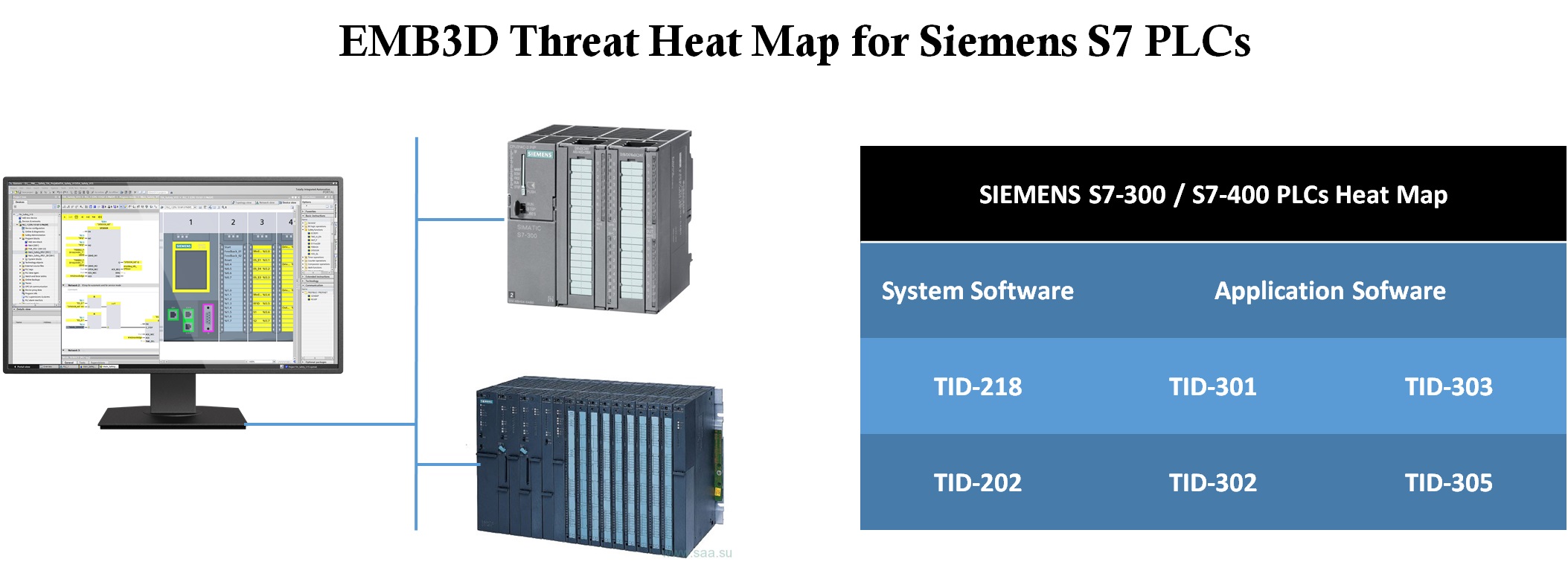
In this article, I show how I used the MITRE EMB3D™ Threat Model to identify vulnerabilities in SIEMENS PLCs that were exploited by the Stuxnet worm to sabotage the Iran’s nuclear centrifuges.

In this article, I show how I used the MITRE EMB3D™ Threat Model to break down the experiment of Thales satellite hacking demo at CYSAT 2023, identify key lessons learned, and record possible countermeasures.

SPARTA v3.2: Raising the Bar for Threat‑Informed Space Cybersecurity

0

The Aerospace Corporation has released SPARTA v3.2, further strengthening its role as a practical, threat‑informed framework for securing modern space missions against sophisticated cyberattacks.

This new version refines the way engineers connect adversary behaviors, defensive controls, and detection artifacts across the full space architecture, from ground segment to on‑orbit payloads.

Why SPARTA Still Matters for Space Programs

SPARTA (Space Attack Research and Tactic Analysis) is an ATT&CK‑like knowledge base dedicated to cyber threats targeting spacecraft and space systems.

It provides a structured matrix of techniques, countermeasures, and indicators of behavior (IOBs) that helps mission teams move from generic security requirements to concrete, space‑specific threat models and mitigations.

In recent years, SPARTA has become a reference for space‑cybersecurity practitioners because it:

  • Describes how real adversaries operate across the space mission lifecycle, not just at the IT perimeter.
  • Bridges policy and engineering by mapping techniques to NIST controls, CNSS guidance, and other standards relevant to space programs.
  • Enables threat‑informed engineering, linking attack techniques directly to subsystem protections and detection strategies.

SPARTA v3.2 builds on this foundation with targeted improvements that make the framework more actionable for system engineers, mission architects, and security operations teams.

Key Enhancements in SPARTA v3.2

SPARTA v3.2 focuses on improving clarity, consistency, and operational usability across the framework’s content and tooling.

While previous releases introduced major new capabilities (such as dedicated NIST space segment guidance and new IOBs), this version consolidates that progress into a more robust and user‑friendly baseline.

Among the main updates highlighted in the official announcement:

  • Refined technique and countermeasure content
    SPARTA v3.2 includes editorial and structural updates to several existing techniques and countermeasures to improve naming consistency, descriptions, and relationships across the matrix.
    This helps practitioners more quickly identify relevant entries for their specific mission scenarios and reduces ambiguity when performing threat modeling or control mapping.
  • Improved cross‑mapping hygiene
    The release tightens the way SPARTA objects reference external taxonomies such as NIST SP 800‑53, CNSSI overlays, and related guidance, ensuring that mappings remain aligned with the latest space‑segment interpretations.
    For security architects, this means smoother traceability from high‑level requirements down to concrete mitigations tied to SPARTA techniques.
  • ​Bug fixes and data quality improvements
    As with previous iterations, SPARTA v3.2 incorporates corrections to metadata, relationships, and UI behavior discovered by users and the Aerospace team.
    These changes are less visible than new techniques, but they directly improve the reliability of SPARTA‑based analyses and automation pipelines.

Even if v3.2 does not radically expand the matrix, it significantly sharpens the consistency and operational value of the existing content.

Practical Impact for Space‑Cyber Engineers

For engineers already using SPARTA for space threat modeling, v3.2 is an opportunity to refresh models, scripts, and training material against a more stable baseline.

Teams that map SPARTA techniques to their own internal control catalogs or test cases should consider re‑syncing to the updated data set to benefit from the clarified descriptions and mappings.

Concretely, SPARTA v3.2 helps:

  • Make risk discussions with program management more concrete, by using clearer technique language and more precise references to external standards.
  • Align design reviews and security controls with the latest thinking on space segment cybersecurity, without losing the ATT&CK‑style structure engineers are familiar with.
  • Support downstream tooling, such as SPARTA‑powered detection or assessment platforms, that rely on consistent identifiers and relationships.

An example use case is a mission team updating its threat model for a new satellite bus: by re‑baselining on SPARTA v3.2, they can ensure that techniques, countermeasures, and mapped controls reflect the current Aerospace guidance and community feedback.

Looking Ahead

The SPARTA roadmap over the last few years (from v3.0 to v3.2) shows a clear trend: iterative, practical improvements that keep the framework aligned with evolving space‑cyber threats and policy updates.

Instead of one‑off releases, SPARTA is evolving as a living, curated knowledge base that the space community can depend on for threat‑informed engineering.

As space missions grow more complex and interconnected, having a stable yet continuously refined framework like SPARTA v3.2 is essential for bridging the gap between high‑level standards and real‑world adversary behavior.

If you are working on space mission cybersecurity and have not revisited SPARTA recently, this new version is a good moment to do so and to integrate it more deeply into your architectures, reviews, and training workflows.

To go further

Thank’s to Brandon Bailey, Dan Painter, Brad Roeher and Randi Tinney from The Aerospace Corporation for this major SPARTA update.

  • View this official update on Medium here
  • Check all our articles on SPARTA here

Introducing the new MITRE Embedded Systems Threat Matrix (ESTM)

0

Embedded systems have become the unsung heroes of modern technology. They power our satellites, medical devices, vehicles, and industrial infrastructures, quietly operating at the intersection of the physical and digital worlds. But as these systems grow more interconnected, they also become more exposed to increasingly sophisticated cyber threats.

To address this challenge, MITRE has released a new framework: the Embedded Systems Threat Matrix (ESTM). Building on the success of ATT&CK and other MITRE knowledge bases, ESTM brings a much‑needed structure to understanding adversarial behaviors targeting embedded and cyber‑physical environments.

This article provides a concise and accessible introduction to MITRE ESTM, exploring its purpose, structure, and innovation. It also opens the door to future discussions on how this framework could reshape embedded security practices, from industrial control to space systems.

A New Chapter in Embedded Systems Security

Over the past decade, embedded systems have quietly become the invisible backbone of our daily lives. From cars that can park themselves to satellites orbiting Earth, from medical devices monitoring our health to industrial controllers powering entire cities, embedded technologies are everywhere. Yet, as their intelligence and connectivity have grown, so too has their exposure to sophisticated cyber threats.

Until recently, defenders lacked a dedicated framework to understand and categorize these threats in a structured way. The MITRE ATT&CK framework offered a powerful approach for enterprise IT and cloud environments, but its coverage stopped short at the hardware–firmware boundary. Recognizing this gap, MITRE recently unveiled the Embedded Systems Threat Matrix (ESTM), a new framework designed specifically to map the tactics and techniques attackers use against embedded systems.

ESTM marks a strategic evolution in the way we think about cyber defense. It brings together insights from both the hardware and software worlds, helping engineers, analysts, and security architects speak a common language when assessing risks to embedded or mission-critical systems. In doing so, it opens the door to more coherent, system-wide protection strategies at a time when the digital and physical domains are more intertwined than ever.

Why Embedded Systems Need Their Own Threat Framework

Cybersecurity frameworks have matured significantly over the years, guiding organizations in understanding, detecting, and responding to threats targeting IT and cloud infrastructures. Yet, when it comes to embedded systems, these same frameworks fall short. The problem isn’t the intent, it’s the context. Embedded systems operate under constraints and architectures that differ fundamentally from laptops, servers, or virtual machines.

Many of these systems run on specialized hardware, often with proprietary firmware and limited computational resources. They’re built to last decades, not years, which means they frequently outlive the technologies and security controls that once protected them. Updating or patching them can be complex or even impossible, especially when they’re deployed in satellites, industrial control systems, or medical environments.

Beyond technical challenges, there’s also a difference in threat behavior. Attackers targeting embedded environments may exploit physical access, real-time communication protocols, or even electromagnetic emissions, vectors rarely considered in traditional cybersecurity models. These nuanced attack surfaces require a framework that can reflect both digital and physical realities.

This is precisely where the MITRE Embedded Systems Threat Matrix (ESTM) steps in. It recognizes that embedded systems inhabit a hybrid world, where bits and circuits coexist, and where compromise can have tangible, real-world consequences. By providing a dedicated structure for mapping these threats, ESTM enables organizations to anticipate, analyze, and mitigate attacks that traditional IT frameworks were never designed to handle.

Overview of the MITRE ESTM Framework

The MITRE Embedded Systems Threat Matrix (ESTM) was developed to provide a clear, structured way to describe how adversaries target and exploit embedded systems. It follows the same philosophy that made MITRE ATT&CK so influential, a knowledge base of adversarial behaviors organized by tactics and techniques, but adapts it to the unique realities of embedded architectures.

At its core, ESTM lays out the tactics, the high-level adversarial goals, and the techniques attackers might use to achieve them within an embedded context. These tactics reflect the entire attack lifecycle, from gaining access to maintaining persistence or disrupting functionality. What makes ESTM distinctive is its attention to embedded-specific aspects: hardware manipulation, firmware compromise, supply chain interference, and even impacts on safety-critical operations.

The framework organizes these behaviors in a matrix format, helping analysts visualize how attacks evolve across multiple layers of a system, from sensors and controllers to communication buses and firmware. This visual model not only supports post-incident analysis but also aids system designers in anticipating and preventing potential weaknesses during development.

Like MITRE’s other frameworks, ESTM is meant to be dynamic and collaborative. MITRE encourages researchers, integrators, and industry partners to contribute new techniques and examples as threats evolve. In that sense, ESTM is more than a static reference, it’s a living framework designed to grow alongside the technologies it aims to protect.

Key Features and Innovations of MITRE ESTM

What sets the MITRE Embedded Systems Threat Matrix apart is its deep alignment with the physical realities of embedded technologies. Unlike traditional cybersecurity models that focus primarily on software exploitation, ESTM expands the lens to include hardware, firmware, and the often-overlooked interfaces that connect the two. This holistic approach gives defenders a more accurate picture of how threats materialize and propagate in complex embedded environments.

One of ESTM’s most notable features is its ability to map attacks that span multiple domains, for example, an adversary injecting malicious firmware during manufacturing, then exploiting communication protocols once the system is deployed. Such cross-domain visibility is essential for industries like aerospace, automotive, and industrial control, where embedded systems are tightly integrated into broader operational networks.

Another innovation lies in the framework’s hardware-aware tactics. ESTM covers areas such as physical tampering, fault injection, and firmware modification, attack vectors that rarely appear in IT-oriented matrices. By including these dimensions, the framework bridges the gap between traditional cyber threat modeling and hardware-level security analysis.

MITRE has also designed ESTM to complement existing frameworks like ATT&CK and D3FEND. This interoperability means defenders can link embedded-specific techniques to established detection, mitigation, and response strategies. The result is a more coherent defense ecosystem, where insights from the digital and physical layers reinforce one another.

Ultimately, ESTM is not just a new taxonomy, it’s a unifying language for diverse teams. By helping engineers, researchers, and analysts describe threats in consistent terms, it accelerates collaboration and enables proactive design choices that make embedded systems more resilient from the start.

How Organizations Can Use ESTM

For many organizations, the challenge with embedded security isn’t just identifying vulnerabilities, it’s understanding how they fit into the bigger picture of system risk. The MITRE Embedded Systems Threat Matrix (ESTM) offers a structured way to bridge that gap. By modeling potential attacker behaviors rather than isolated weaknesses, ESTM helps teams move from reactive patching to proactive defense planning.

In practice, ESTM can serve multiple roles. Security architects can integrate it into the early stages of system design to evaluate how different components, processors, controllers, communication modules, might be targeted. Red teams and penetration testers can use the matrix as a roadmap to craft realistic attack scenarios that reflect how real adversaries operate in embedded environments. Meanwhile, defenders can use the same framework to prioritize mitigations based on which tactics are most relevant to their architecture or industry.

ESTM also supports regulatory compliance and internal assurance. As industries such as automotive, aerospace, and energy adopt stricter cybersecurity standards, mapping system threats to an established framework provides traceable evidence of due diligence. The structured language of ESTM also helps align security discussions between engineering, compliance, and incident response teams, a critical step in achieving true “secure-by-design” outcomes.

Finally, the framework can be a powerful educational tool. By visualizing how complex attacks unfold across the hardware–software boundary, it helps professionals from different backgrounds, network security, embedded engineering, operations, build a shared understanding of emerging risks. This shared perspective is crucial as embedded systems increasingly underpin the world’s most critical infrastructures.

MITRE ESTM vs. Other Frameworks (Opening Future Comparisons)

The release of the MITRE Embedded Systems Threat Matrix (ESTM) doesn’t exist in a vacuum. It joins a growing ecosystem of frameworks that help researchers and engineers better understand how adversaries target highly specialized systems. Among these, MITRE’s EMB3D and The Aerospace Corporation’s SPARTA framework stand out as strong points of comparison.

While the EMB3D knowledge base focuses on cataloging vulnerabilities and attack patterns specific to embedded devices, ESTM takes a broader, behavior‑driven approach. It maps the tactics and techniques adversaries use across the full attack lifecycle, offering a perspective that goes beyond known vulnerabilities to capture attacker intent and methodology. In this sense, EMB3D and ESTM are complementary: one documents what can be exploited, while the other explains how and why these exploits may occur.

The SPARTA framework (Space Attack Research and Tactic Analysis) developed by The Aerospace Corporation provides another valuable point of alignment. SPARTA is focused on space‑system resilience, offering a structured method to model, visualize, and analyze attacks against satellites and ground segments. ESTM’s methodology could integrate naturally with SPARTA’s domain‑specific modeling by providing detailed embedded‑level insights, especially for spacecraft subsystems, mission processors, and communication interfaces.

Together, frameworks like ESTM, EMB3D, and SPARTA suggest a promising path toward more unified and cross‑domain threat modeling. By connecting embedded‑system and space‑system perspectives, cybersecurity professionals can better anticipate how adversarial behavior spans from microcontrollers on Earth to mission architectures in orbit.

Future Research Directions and Case Study Ideas

As with many of MITRE’s frameworks, the real value of the Embedded Systems Threat Matrix will emerge through community adoption and experimentation. Researchers, engineers, and analysts have a unique opportunity to apply ESTM to real-world scenarios, uncovering new insights into how embedded systems can be better protected. The framework’s adaptable structure lends itself perfectly to comparative and exploratory studies.

One promising avenue would be a detailed analysis of the Thales satellite hacking demonstration at CYSAT 2023, this time interpreted through the lens of the ESTM framework. Mapping each step of the simulated intrusion, from access to payload execution, against ESTM’s tactics could help illustrate how attackers might compromise spaceborne embedded systems and what defensive gaps remain.

Another study could revisit the infamous Stuxnet incident, applying ESTM to model the techniques used against Siemens PLCs. This exercise would not only highlight how early campaigns against industrial control systems anticipated modern embedded attack vectors, but also show how frameworks like ESTM could have helped identify weak points earlier in the system lifecycle.

Finally, industrial control and automation environments present an ideal testing ground for ESTM-driven modeling. Using the framework to visualize attacks on programmable logic controllers (PLCs) or distributed control networks could guide both defensive engineering and cybersecurity training initiatives.

These case studies would do more than validate the framework, they would help shape its evolution. Each analysis could contribute new examples, refine existing categories, or inspire sector-specific adaptations. In this way, ESTM becomes not just a tool for documentation, but a catalyst for collaborative research and continuous improvement in embedded security.

Conclusion : Towards a Unified Threat Modeling Paradigm for Embedded Systems

The release of the MITRE Embedded Systems Threat Matrix (ESTM) marks an important milestone in the evolution of cybersecurity. It extends structured threat intelligence into a realm that has long operated at the margins of traditional IT defense, the domain of firmware, sensors, processors, and critical control loops. By offering a shared vocabulary and methodology, ESTM helps bridge the gap between embedded design and cybersecurity analysis.

More than a reference, the framework invites collaboration. Its greatest strength lies in its capacity to grow, to absorb lessons from real-world incidents, research initiatives, and the practical experiences of engineers and defenders. As industries increasingly depend on embedded technologies to operate safely and efficiently, the need for a unified approach to threat modeling becomes not just desirable but essential.

Whether applied to satellites, industrial automation, connected vehicles, or future cyber-physical systems, ESTM represents a step toward that unity. It offers the foundation for a future where embedded security is no longer reactive, isolated, or opaque, but instead integrated, transparent, and continuously improved through global knowledge sharing.

In that sense, MITRE ESTM is more than just a framework; it is an open invitation for the cybersecurity community to build the next generation of protection for the systems that quietly run our world.

To know more

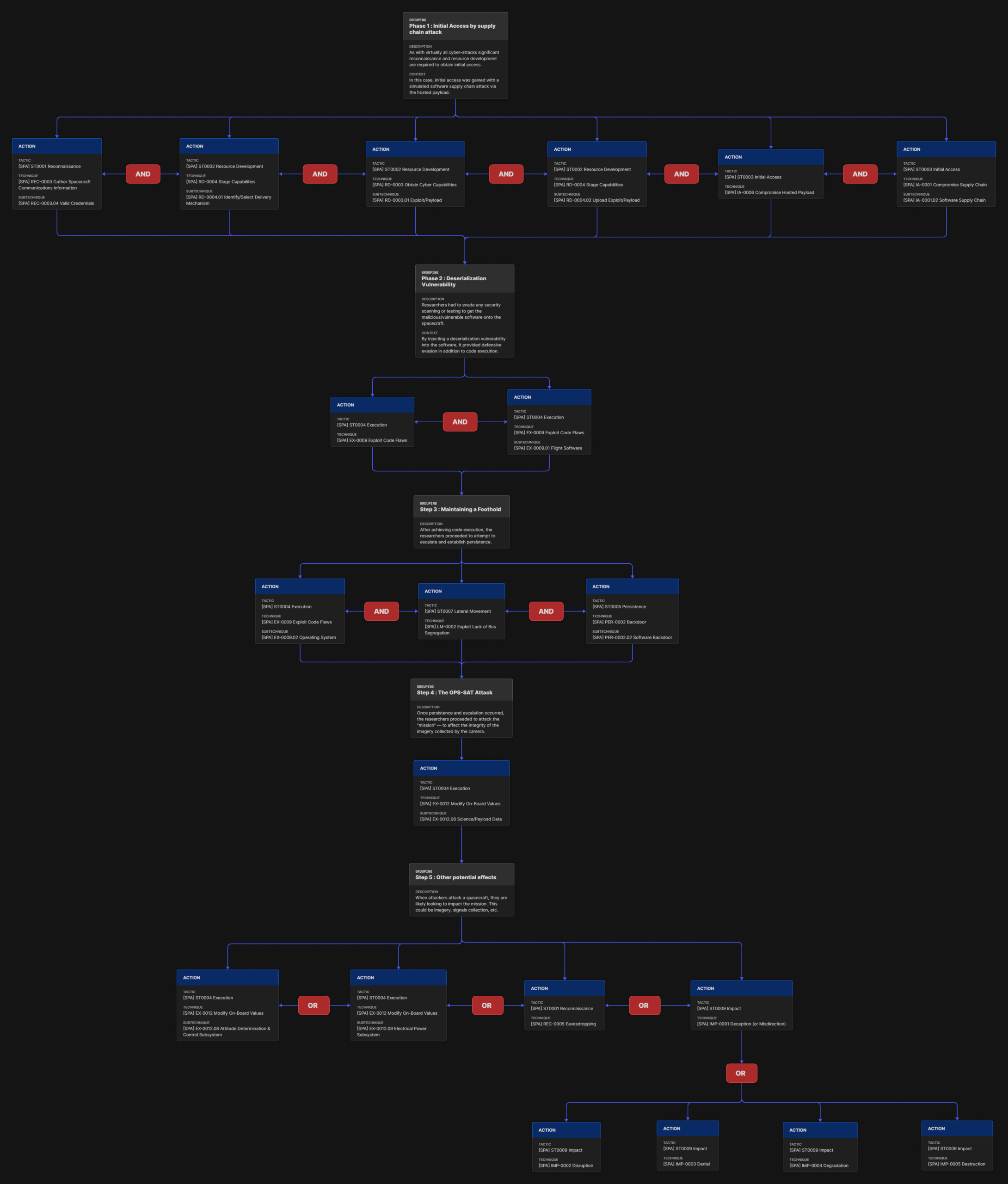
Mapping the Thales Satellite Hacking Demo using SPARTA TTPs and PWNSAT ATT&CK Flow Builder fork

0

In 2023, during the CYSAT conference, Thales presented a live demonstration of a satellite hacking scenario, a milestone event that shed light on the cybersecurity challenges of modern space systems. Since then, various experts have analyzed this simulation to better understand how cyberattacks could target satellite architectures and mission operations.

Context and Background

As part of this effort, Brandon Bailey and Brad Roeher from the SPARTA team conducted a detailed analysis of the Thales demonstration using the SPARTA (Space Attack Research and Tactic Analysis) Framework. Their work, which I describe in this article, identified the key Tactics, Techniques, and Procedures (TTPs) involved across the attack lifecycle, creating a foundation for understanding adversarial behavior in space environments.

In parallel, Kevin Jahaziel Leon Morales and Romel Marin from the PWNSAT team extended the MITRE ATT&CK Flow Builder tool to natively integrate the SPARTA framework. This enhancement allows researchers to automatically generate and visualize space-specific attack flows, a breakthrough for modeling realistic cyberattack scenarios targeting satellites and related ground segments.

My Objective and Methodology

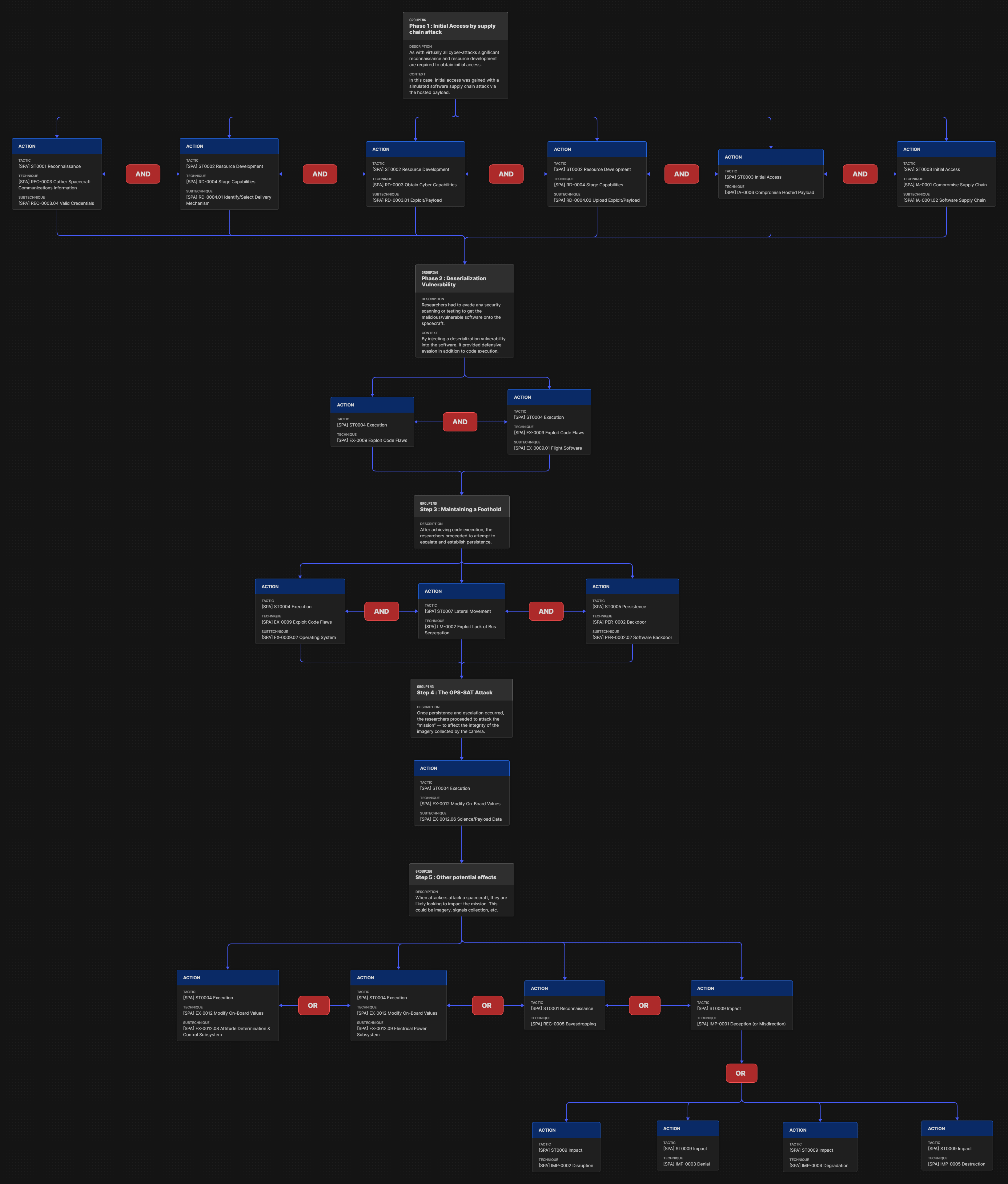
Building on these complementary works, I set out to reconstruct the entire attack flow of the Thales satellite hacking demo using this upgraded ATT&CK Flow Builder. My goal was to combine the analytical rigor of SPARTA TTPs identified by the SPARTA team with the visual modeling capabilities of the MITRE ATT&CK Flow Builder modified by the PWNSAT team.

I already conducted a such work by modeling Viasat Cyber Attack but with the real MITRE Attack Flow Builder. You can check this work in this article in which I also explain what is the Attack Flow Builder Tool designed by MITRE Engenuity’s Center for Threat-Informed Defense (CTID).

How I achieved this work

The methodology described below is showing the building process that I used to achieve this work :

  1. I collected the TTPs identified by the SPARTA team (Bailey and Roeher) during their analysis of the Thales demonstration.
  2. I used the pwnsat-modified ATT&CK Flow Builder, which supports direct integration with SPARTA taxonomy.
  3. I constructed a visual diagram mapping the complete sequence of attacker actions, from initial access through payload manipulation to mission impact.
  4. I validated the consistency of each mapped step with the SPARTA methodology to maintain analytical accuracy.

The resulting diagram captures not only the technical flow of the attack but also the relationships between threat actions, affected assets, and tactical objectives.

Result of my work

The diagram below is showing the result of my work. Original file in big format can be found below.

Text inside the grouping action box are from SPARTA.

The format used for creating and editing in the Attack Flow Builder is the AFB builder  format (.afb). The AFB file below can be used to open the project for further editing in the future.

The PNG format is used to save the flow. This format is great for visualizing, using in presentations, sharing with others, etc..

Why This Work Matters

This experiment serves multiple purposes:

  • Educational value: It helps practitioners and researchers visualize how real-world satellite attacks unfold, bridging the gap between theoretical TTPs and operational behaviors.
  • Framework interoperability: It demonstrates how SPARTA and MITRE ATT&CK can coexist and complement each other in cyber threat modeling.
  • Scenario replication: The approach can be reused to analyze other aerospace or defense-related use cases, accelerating structured threat simulation and red-team exercise design.
  • Community advancement: By using open frameworks and shared methodologies, this work contributes to a growing ecosystem of collaborative research in space cybersecurity.

For further details

Next Steps

By sharing both the diagram and the building process with the research community, my goal is to encourage others to apply the same methodology to new studies. Whether you’re an academic researcher, a red teamer, or part of a mission assurance team, these tools can help you better model and mitigate cyber risks in space systems.

2nd International Conference on Gravitation, Astrophysics and Cosmology (ICGAC2026) – April 16-18, 2026 in Paris, France.

0

We are pleased to announce that the 2nd International Conference on Gravitation, Astrophysics and Cosmology (ICGAC2026) will be held on April 16-18, 2026, in the vibrant city of Paris, France. This prestigious event aims to bring together leading researchers, scientists, and students from around the world to share the latest advancements and research findings in the dynamic fields of gravitation, astrophysics, and cosmology.

ICGAC2026 is designed to foster insightful discussions and collaborations by featuring keynote talks from renowned experts, sessions on cutting-edge topics such as Gravitation Physics and Lensing, Applied Relativity, Solar and Stellar Physics, Applied Physics, and Neutrino Cosmology. The conference provides a unique platform for networking among academic and industry professionals, promoting new partnerships and the exchange of groundbreaking scientific ideas.

Participants will have the opportunity to explore future directions in astrophysics, attend impactful discussions, and contribute to shaping the evolution of astronomical science.

Join the conference in Paris to engage with top leaders, distinguished delegates, and passionate students in an inspiring scientific journey that highlights the latest research and innovations in the universe’s mysteries.

Why attend ICGAC 2026 ?

  • Gain exclusive insights from experts who are redefining our understanding of gravitation, cosmology, and astrophysics.
  • Engage in meaningful discussions on some of the most debated topics in modern physics, including the nature of dark energy, black holes, and cosmological frameworks.
  • Build valuable connections with leading scientists, independent researchers, and innovators from around the world.
  • Experience an interdisciplinary exchange of ideas that could shape the future of space science and cosmology.

📅 𝗘𝘃𝗲𝗻𝘁 𝗗𝗲𝘁𝗮𝗶𝗹𝘀
📌 𝗗𝗮𝘁𝗲𝘀: April 16–18, 2026
📌 𝗩𝗲𝗻𝘂𝗲: Paris, France
📌 𝗢𝗿𝗴𝗮𝗻𝗶𝘇𝗲𝗱 𝗯𝘆: Conplus Meetings

For more details and registration, visit the official conference website at https://astrophysics2026.conplusmeetings.com/

List of Scientific Sessions

  • Computational Cosmology
  • High Energy Nuclear and Particle Physics
  • Wave-Particle Duality
  • Multi-Messenger Astronomy
  • Dark Matter and Dark Energy Around Black Holes
  • Gravitational Physics and Lensing
  • Solar and Stellar Physics
  • Neutrino Cosmology
  • Alternative Theories of Gravity
  • Gravitational Waves and High-Energy Phenomena
  • Astrobiology
  • Interstellar Medium and Star Formation Regions
  • Space Telescopes and Missions
  • Cosmic Rays and Gamma Astronomy
  • Space Missions & Satellites
  • Cosmic Microwave Background and Radiation
  • Earth and Space Physics
  • Evolution of Celestial Objects
  • Jet Physics & Applied Physics
  • Planetary Science and Earth Science
  • Theoretical Astrophysics
  • Neutrino Cosmology
  • Relativistic Celestial Mechanics
  • Galaxy Formation and Evolution
  • High Stellar Mass Galaxies at High Redshifts
  • Observational Astronomy

Two big announcements : the release of SPARTA v3.1 with MITRE’s EMB3D mapping and the release of a MITRE Attack Flow Builder fork using the SPARTA Framework

1

In the following article, discover the major advancements announced with the release of SPARTA v3.1: the addition of new NIST space segment guidance, the integration of MITRE EMB3D into the SPARTA framework by mapping TTPs, and the unveiling of an extended MITRE ATT&CK Flow builder supporting the SPARTA framework for aerospace security use cases.

SPARTA v3.1: A Major Leap for Space Cybersecurity

The recent release of SPARTA v3.1 marks a significant milestone in advancing cybersecurity for space missions and infrastructure. This update solidifies SPARTA’s role as the reference framework for identifying, mapping, and mitigating threats to spacecraft and space-enabled services.

New: Space Segment Guidance for NIST Controls

SPARTA v3.1 introduces dedicated guidance for applying NIST cybersecurity controls specifically to the space segment, including spacecraft payloads, buses, and specialized communication modules. This new layer helps organizations better map traditional NIST requirements to the unique risks and workflows of space assets, supporting compliance efforts for both government and commercial operators.

Integration with MITRE’s EMB3D: TTP Mapping

A pivotal enhancement is the integration and mapping of SPARTA’s Tactics, Techniques, and Procedures (TTP) to MITRE’s EMB3D threat model for embedded devices. By linking SPARTA TTPs with EMB3D’s taxonomy, security teams can coordinate countermeasures and risk assessments between space and embedded domains, offering unprecedented interoperability for spacecraft, ground, and IoT systems.

For further details, explore the official SPARTA updates here : https://medium.com/the-aerospace-corporation/sparta-v3-1-whats-new-58d6b91b1505

A MITRE ATT&CK Flow Builder fork that supports SPARTA

In parallel, Kevin Jahaziel Leon Morales and Romel Marin have have expanded the MITRE ATT&CK Flow builder to natively incorporate the SPARTA framework. This enables automated and graphical creation of attack flows tailored to aerospace technologies and missions, boosting the analysis and simulation of realistic cyberattack scenarios based on SPARTA data.

For further details, explore this related research on unified attack flows in the space and embedded domains here : https://pwnsat.org/blog/from-mitre-attck-to-sparta-a-unified-attack-flow-for-space-systems/

If you want to test this fork check the repo here and check the UI here.

Why These Updates Matter

  • Stronger Space Domain Resilience: The new NIST mapping brings formal cybersecurity maturity to satellite and mission assets.
  • Seamless Threat Modeling: The EMB3D integration bridges embedded and space system security, streamlining threat tracking and mitigation.
  • Operational Alignment: Enhanced tools like the ATT&CK Flow Builder empower red and blue teams to simulate, document, and strengthen defenses based on real-world tactics.
  • Community Growth: These changes reflect the continued collaboration between aerospace stakeholders and leading threat intelligence bodies to keep space assets secure in an evolving threat landscape.

SPARTA v3.1 stands as a robust, forward-looking framework that helps the aerospace community translate cutting-edge threat information into actionable defenses for the vital missions of tomorrow.

For further details

An analysis of the Thales satellite hacking demo at CYSAT 2023 with the METEORSTORM™ framework and the AI-CoPilot (Part 1)

0

Disclaimer

Please be informed that the analysis detailed in this article is entirely separate from the hacking experiment conducted by the Thales team on the satellite.

Both activities are independent of each other and were carried out by different teams. There is no association between me and the team that conducted the hacking experiment.

This work is conducted on a personal basis and is independent of my work at Thales. Thales is in no way involved in this work, and Thales’s responsibilities cannot be engaged under any circumstances.

All slides embedded in this article are public slides presented by Thales during the CYSAT 2023 conference and available in the Youtube video which presents the Thales experiment.

Purpose of the article

This article is part of a series of articles on the analysis of the Thales satellite hacking demo at CYSAT 2023 with the METEORSTORM™ framework and the AI-CoPilot.

Recently, I discovered the METEORSTORM™ framework built by EthicallyHackingspace (eHs)®. I was lucky to be offered a preview of how to use this new framework by participating in and successfully completing a challenge exam which is still in beta version. The success of this exam allowed me to obtain the certification: Full Spectrum Space Cybersecurity Professional (SCOR Practitioner).

As I now know how to use the METEORSTORM™ framework correctly, I propose to show, in this series of articles, how I used the METEORSTORM™ and its AI Copilot to:

  • break down the experiment of Thales satellite hacking demo at CYSAT 2023,
  • design the Threat Model with known and theoretical attack paths,
  • record resilience and possible counter measures,
  • identify detection measures,
  • model Indicators of Compromise (IoC) and Recovery Resilience for the Incident Response Preparation phase.

Brandon Bailey and Brad Roeher from the SPARTA team already did an analysis of the Thales satellite hacking demo (summarized in this article, full article here) but with the SPARTA framework.

On my side, I have also already conducted an analysis of the Thales satellite hacking demonstration (full article here) but using the MITRE EMB3D™ framework.

The goal with this series of articles is to go further by using METEORSTORM™,  a modeling and analytic framework purpose-built to assess and enhance resilience across converged space systems.

Hacking demo at CYSAT 2023: what was the point again

To know more about the Thales hacking demo at CYSAT 2023, I encourage you to visit the following pages here, here and here where the results of the ethical satellite hacking exercise is detailed.

What is OPS-SAT

To know more about the Thales hacking demo at CYSAT 2023, I encourage you to visit the following page here where OPS-SAT, a small, CubeSat-class satellite developed by the European Space Agency (ESA) to serve as a testbed for innovative software, systems, and operational concepts in space, is detailed.

What is METEORSTORM™

METEORSTORM™ stands for Multiple Environment Threat Evaluation of Resources, Space Threats, and Operational Risks to Missions.

METEORSTORM™ is a modeling and analytic framework purpose-built to assess and enhance resilience across converged space systems. Its core strengths include:

  • Layered decomposition across physical environments, system segments, services, and assets.
  • Analytic enrichment drawing from leading frameworks (e.g., MITRE ATT&CK™, D3FEND™, CAPEC™, ATLAS™, FIGHT™, EMB3D™, ESA Space Shield, Aerospace SPARTA, NIST SP 800-160 Vol. 1 & Vol. 2, and NIST SP 800-53).
  • Support for hybrid architectures, including terrestrial, aquatic, aerial, orbital, and deep space domains.

The METEORSTORM™ framework is accompanied by a AI-Copilot platform. The AI Co-Pilot is an evolving assistant that guides real-time analysis and decomposition workflows.

The METEORSTORM™ framework is executed through six strict functions, each dependent on the prior, forming a traceable and enforced modeling sequence:

  • Function One – Concept of Operations (CONOPS) : Models the nominal state of a space platform by enforcing layered decomposition: PCE (Primary Capability Environment), SEG (Segment), SVC (Service), AST (Asset), AN (Analytic Enrichment)
  • Function Two – Threat Model : Models known/theoretical attack paths (AN: ATT) and resilience measures (AN: RES).
  • Function Three – Detection Engineering : Transforms threats into detection logic using AN: DET and AN: IOA.
  • Function Four – Incident Response Preparation : Models Indicators of Compromise (AN: IOC) and Recovery Resilience (AN: RES)
  • Function Five – Adversary Management : Overlays real or theoretical adversaries to defined behaviors.
  • Function Six – Commercial Hybrid Warfare Attribution : Final function. Attributes actions to dual-use or commercial actors.

EthicallyHackingspace (eHs)® is working on launching a certification portal in a few months. In the upcoming weeks a few other community professionals will be invited to participate in the exam challenge process until it is finalized in August.

To know more about the METEORSTORM™ framework, check our article here.

Analysis of OPS-SAT with Function One – Concept of Operations (CONOPS)

At this stage, we will model the OPS-SAT platform by decomposing it into its environment, segments, services, and assets to establish a traceable baseline before introducing threats.

Technical Features of OPS-SAT overview

  • ARM-based onboard computer with 10× the power of standard ESA satellite computers.
  • Reconfigurable software platform, allowing remote code uploads and flexible updates.
  • Includes:
    • Camera with high-resolution imagery.
    • GPS receiver.
    • S-band and UHF radios.
    • AI processing onboard, and support for satellite cybersecurity research

Full decomposition of OPS-SAT is described in the following article

Below is the full METEORSTORM™ decomposition for OPS-SAT based on Function One: Concept of Operations (CONOPS) — fully compliant with the strict taxonomy, sequencing, and validation rules defined in the framework.

Layer Entry
PCE
  • PCE: OR: Orbital: 00: LEO: Low Earth Orbit operational environment for technology demonstration (mission duration: launched 18 Dec 2019, deorbited 22 May 2024)
SEG
  • SEG: SP: Space: 00: Experimental Orbital Segment (3U CubeSat nanosatellite platforms)
SVC
  • SVC: CO: Control Plane: 00: Autonomous Control & Experimentation Service: Provides onboard command execution, software testing, and reconfigurable mission logic
AST
  • AST: FI: Firmware: 00: Reprogrammable Control Logic: Field-updatable firmware enabling dynamic upload of command and experiment control modules
  • AST: HA: Hardware: 00: ARM-Based Onboard Computer: High-performance processor allowing AI/ML software tests and high-fidelity data processing
  • AST: HA: Hardware: 01 ADCS & Camera Payloads: Includes fine ADCS, imager for experiments and astrometry
  • AST: HA: Hardware: 02: GPS Receiver: Provides navigation and timing functionality
  • AST: HA: Hardware: 03: SDR & Optical Receiver: Software-defined radio, optical downlink receiver for communications
  • AST: CI: Communications: 00: S-band CCSDS Uplink/Downlink: Syrlinks EWC31 transceiver used for primary telemetry and command
  • AST: CI: Communications: 01: X-band Payload (via CNES): Experimental high-speed downlink
  • AST: CI: Communications: 02: UHF Backup Link: Redundant link for telemetry & commands
  • AST: SO: Software: 00: Remote Experiment Execution Stack: Software interface for executing uploaded experiments from ESA or external contributors
  • AST: SI: Signal: 00: S-Band Uplink Receiver: Signal channel used for command uplink and experimental software transfer
  • AST: DA: Data: 00: Onboard Experiment & Telemetry Logs: Operational data and telemetry captured from experimental runs for downlink and analysis

Analysis of Thales hacking demo with Function Two – Threat Model (using attack paths AN: ATT only)

At this stage, in this article, for the moment, we will deconstruct the Thales experiment with METEORSTORM™ Function Two – Threat Model but only with attack paths using AN: ATT elements.

In the next article, we will compete the METEORSTORM™ Function Two – Threat Model with resilience measures using AN: RES elements.

In the other articles of this series, we will complete this article and build a full threat model by adding all the other functions of the METEORSTORM™ framework :

  • Function Two – Threat Model : with resilience measures using AN: RES elements
  • Function Three – Detection Engineering : Transforms threats into detection logic using AN: DET and AN: IOA.
  • Function Four – Incident Response Preparation : Models Indicators of Compromise (AN: IOC) and Recovery Resilience (AN: RES)
  • Function Five – Adversary Management : Overlays real or theoretical adversaries to defined behaviors.
  • Function Six – Commercial Hybrid Warfare Attribution : Final function. Attributes actions to dual-use or commercial actors.

The figure below is showing a summary of the full attack flow used by the Thales team to conduct the attack on OPS-SAT.

Figure 4: Summary of the full attack flow (Slide courtesy Thales Group)

Since the Thales OPS-SAT attack is multi-stage, we can model each phase as its own discrete AN: ATT element. This approach aligns with the METEORSTORM™ enforcement model and supports full traceability for detection and resilience mapping.

Here is the full, six-stage multi-vector attack path (AN: ATT: 00–05) for the OPS-SAT satellite hacking scenario. Each stage includes:

  • Detailed descriptions
  • Full SPARTA and EMB3D mappings
  • Targeted METEORSTORM™ asset layer tags

Step 1: Unsafe Java deserialization (AN: ATT: 00 – Initial Access via Unsafe Java Deserialization)

To introduce the compromised or flawed software onto the spacecraft, the team needed to bypass security checks and evaluations. To achieve their objective, they introduced a deserialization vulnerability into the software, enabling defensive mechanism evasion and potential exploitation for executing arbitrary commands.

Figure 5: The Deserialization Vulnerability (Slide courtesy Thales Group)
With the METEORSTORM™ framework, this translates to:
Layer Entry
AN AN: ATT: Attack Path: 00: Initial Access via Unsafe Java Deserialization
Description Description: Attacker uploads a payload containing crafted serialized objects exploiting ESA’s experiment execution logic.
Source Source: Mapped from

Target Target: AST: SO: Software: 00: ESA App Manager (NMF SDK)


Figure 6: Stay Undetected – Success! (Slide courtesy Thales Group)

Step 2: Applications Binaries Modified (AN: ATT: 01 – Application Binary Modification)

Once the insecure deserialization achieved, the team uploaded a malicious code with the deserialization vulnerability to modify the application-level binaries on the remote device to introduce unauthorized code and to execute arbitrary commands on the remote system.

Figure 7: Stay Undetected – Execute Arbitrary Commands (Slide courtesy Thales Group)
With the METEORSTORM™ framework, this translates to
Layer Entry
AN AN: ATT: Attack Path: 01: Post-Upload Binary Modification of Payload
Description Description: Modified the payload in-memory after upload, bypassing ESA signature enforcement to insert shell code.
Source Source: Mapped from

Target Target: AST: FI: Firmware: 00: NMF Runtime Execution Kernel


Step 3: Privilege escalation via the CAN bus (AN: ATT: 02 – Privilege Escalation via CAN Bus)

At this stage, their app runs as an unprivileged Linux user and has no direct access to sensors but though the supervisor. Their objective is now to find system configuration issues or vulnerabilities to realize a privilege escalation from user to root.

They identified that anyone can talk on the CAN bus, including unprivileged apps. And then, all commands send on the CAN bus are executing as root by a client that runs as root and that decodes and executes as root whatever command it receives.

Figure 8: Taking Control – Privilege Escalation from User to Root (Slide courtesy Thales Group)
With the METEORSTORM™ framework, this translates to
Layer Entry
AN AN: ATT: Attack Path: 02: Privilege Escalation via CAN Bus Interface
Description Description: Experiment abuses unsecured access to CAN bus to issue root-level commands bypassing sandbox.
Source Source: Mapped from

Target Target: AST: HA: Hardware: 00: ARM-Based Onboard Computer


Figure 9: Taking Control – Arbitrary Code Execution as Root (Slide courtesy Thales Group)

Step 4: Persistence (AN: ATT: 03 – Persistence via Java Reverse Shell)

At this stage, the app escalated as root. Now, the team needed to ensure persistent effects on sensors. They identified a jar library on the Supervisor that is writable by root user. A jar is simply a zip file, with compiled Java bytecode inside. The team crafted a bytecode based on the original one, and simply replace some files inside the jar. The supervisor now runs the jar containing the malicious bytecode.

Figure 10: Persistence – Injection of a Jar Library (Slide courtesy Thales Group)
With the METEORSTORM™ framework, this translates to
Layer Entry
AN AN: ATT: Attack Path: 03: Reverse Shell Persistence Inside Payload
Description Description: Attacker embedded a Java-based backdoor triggered via timing or command sequence, enabling session persistence.
Source Source: Mapped from

Target Target: AST: SO: Software: 00: Experiment Execution Stack


Step 5: OPS-SAT attack by tampering with camera and ADCS (AN: ATT: 04 – Operational Impact: Tampering with Camera & ADCS)

Once the team escalated as root and ensured persistency, they took control on the supervisor and the demo effects was achieved.

Figure 11: Demo Effects – Tampering with Camera & ADCS (Slide courtesy Thales Group)
With the METEORSTORM™ framework, this translates to
Layer Entry
AN AN: ATT: Attack Path: 04: Payload Tampering – Camera and ADCS Control
Description Description: With elevated access, attacker issued unauthorized commands to alter imaging, navigation, and attitude data.
Source Source: Mapped from

Target Target:

  • AST: HA: Hardware: 01: ADCS
  • AST: HA: Hardware: 02: GPS Receiver
  • AST: HA: Hardware: 03: Optical Sensors


Step 6: Other potential effects (but non demonstrated)

When adversaries target a spacecraft, their primary goal is often to disrupt the mission. This disruption can involve compromising imagery, intercepting signals, or other mission-critical functions. Thales Group demonstrated this by successfully manipulating the payload data transmitted from the spacecraft. They also identified additional potential impacts that could occur if attackers gain further access and maintain their presence, though these were not carried out. With root access and ongoing control, the range of possible attacks becomes virtually unlimited.

  • They could alter/delete all images captured by the camera
  • They could override satellite attitude requested by other apps
  • This also provides persistence for the malicious code since the supervisor starts early and is almost always running
Figure 12: Other Potential Effects (Slide courtesy Thales Group)
With the METEORSTORM™ framework, this translates to
Layer Entry
AN AN: ATT: Attack Path: 05: Other potential effects (but non demonstrated)
Description Description: Thales Group also identified additional potential impacts that could occur if attackers gain further access and maintain their presence, though these were not carried out.
Source Source: Mapped from

Target Target:

  • AST: DA: Data: 00: Onboard Experiment & Telemetry
  • AST: SI: Signal: 00: S-Band Uplink Receiver
  • AST: HA: Hardware: 03: SDR & Optical Receiver: Software-defined radio, optical downlink receiver for communications

Attack Path Summary Table

Here is a clean and structured table presenting all six stages of the OPS-SAT attack path (AN: ATT) mapped from SPARTA and EMB3D Technique(s).

ID Phase Technique(s) – SPARTA / EMB3D Mapping (abbrev) Target Asset
ATT:00 Initial Access Deserialization flaw (EX-0009, EX-0009.01, TID-326) AST: SO: ESA App Manager
ATT:01 Execution Modification Binary tampering Post-Upload (IA-0001.02, IA-0006, RD-0003.01, RD-0004.02, TID-301/302/etc) AST: FI: NMF Runtime
ATT:02 Privilege Escalation Privilege Escalation via CAN Bus (EX-0009.02, LM-0002, T1548, TID-114/412/204/219) AST: HA: ARM-Based Computer
ATT:03 Persistence Persistence via Reverse Shell (PER-0002.02, TID-304/305/203/202/307/308) AST: SO: Experiment Execution
ATT:04 Impact Camera/ADCS tampering (EX-0007.02) AST: HA: ADCS, GPS, Optical Sensors
ATT:05 Other potential effects Modeled Additional Impacts like Eavesdropping, Deception (EX-0012.08, EX-0012.09, EXF-0003, IMP-0001) AST: DA, SI, HA (SDR & Optics)


Next steps to go further

After modeling the nominal state of the OPS-SAT platform with Function One – Concept of Operations (CONOPS) and after Threat Modeling the system with known and theoretical attack paths, the next step of this series of articles is to record resilience measures.

At the end of this series, we will present the advantages of the METEORSTORM™ framework for a Satellite System. We will summarize the key benefits of applying this approach to space assets. We will consolidate our findings, highlight the added value of the METEORSTORM™ framework, and provide practical insights for system designers, cybersecurity architects, and mission planners.

Acknowledgments

Many thanks to ESA, to the CYSAT conference and to the Thales team for making this experiment possible, and for making it so enriching for the community.

A big thank you also to the SPARTA team, who inspired this article and contribute to strengthening the cybersecurity of satellites and space systems.

Congratulations to the ethicallyHackingspace (eHs)® team and William Ferguson for this amazing work!

Exploring the power of the METEORSTORM™ framework — a framework built for full-spectrum modeling of current, emerging, and theoretical converged space-cyber systems

1

I’m very proud to have successfully taken up a new challenge exam in beta version about METEORSTORM™ framework which allowed me to obtain the certification: Full Spectrum Space Cybersecurity Professional (SCOR Practitioner).

Completing the METEORSTORM™ module ensures that I can be part of a work role that is responsible for platform decomposition and analysis to understand and break down space platforms, identifying exposure and developing resilience measures. It also involves preparing Space Collective Defense solutions focused on Collective Development, Research, and Response. Furthermore, this role directly supports organizational and communal efforts in space platform Threat Management, Resilience Engineering, and Breach Management.

EthicallyHackingspace (eHs)® is working on launching a certification portal in a few months.

In the upcoming weeks a few other community professionals will be invited to participate in the exam challenge process until it is finalized in August.

I was lucky to be offered a preview of this new portal and this new challenge exam.

METEORSTORM™ stands for Multiple Environment Threat Evaluation of Resources, Space Threats, and Operational Risks to Missions.

It is a systematic resilience modeling framework specifically designed for converged space systems that face:
  • Kinetic threats (e.g., physical attacks)
  • Non-kinetic threats (e.g., cyber, RF interference)
  • Electronic & Cyber Warfare
  • Environmental exposure risks

METEORSTORM™ is a modeling and analytic framework purpose-built to assess and enhance resilience across converged space systems. Its core strengths include:

  • Layered decomposition across physical environments, system segments, services, and assets.
  • Analytic enrichment drawing from leading frameworks (e.g., MITRE ATT&CK™, D3FEND™, CAPEC™, ATLAS™, FIGHT™, EMB3D™, ESA Space Shield, Aerospace SPARTA, NIST SP 800-160 Vol. 1 & Vol. 2, and NIST SP 800-53).
  • Support for hybrid architectures, including terrestrial, aquatic, aerial, orbital, and deep space domains.

The METEORSTORM™ AI assistant is also beneficial for:

  • Students studying space and cyber convergence.
  • Researchers analyzing resilience strategies for next-gen missions.
  • Security-minded technologists modeling exposure, risk, and mitigation.

METEORSTORM™ framework is amazing. The EthicallyHackingspace (eHs)® team did a great job. I had a lot of fun using the METEORSTORM framework in the challenge exam. METEORSTORM™ is very simple to use and the results are very useful, valuable and actionable.

The model is across multiple domains, including:

  • Drones (terrestrial, aquatic, orbital, deep space)
  • Aquatic systems (beacons, transoceanic cables)

  • Hybrid terrestrial–orbital–aerial platforms

The model allows:

  • Threat modeling & emulation
  • Hybrid warfare scenario analysis
  • Resilience & detection signature engineering

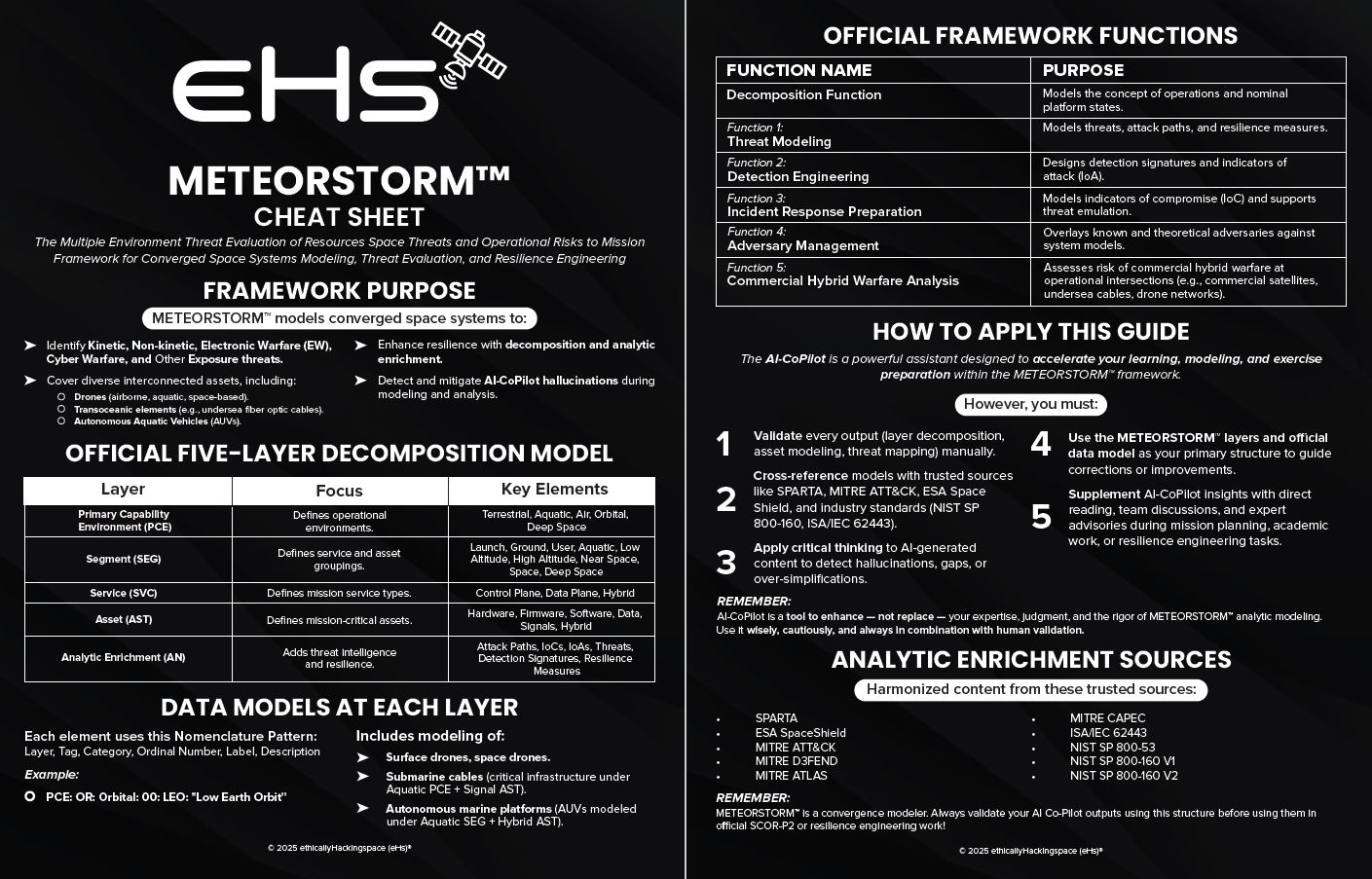
METEORSTORM Cheat Sheet

To know more

You can access the public version of the decomposition and analytic AI-Copilot platform, now open beyond the eHs FS-SCP™ community.

You can see my digital badge here: https://my.certifyme.online/verify/af62246a13653

To know more about ethicallyHackingspace(eHs)®: https://ethicallyhacking.space/

An analysis of the Thales satellite hacking demo at CYSAT 2023 with the MITRE EMB3D™ Threat Model

1

Disclaimer

Please be informed that the analysis detailed in this article is entirely separate from the hacking experiment conducted by the Thales team on the satellite.

Both activities are independent of each other and were carried out by different teams. There is no association between me and the team that conducted the hacking experiment.

This work is conducted on a personal basis and is independent of my work at Thales. Thales is in no way involved in this work, and Thales’s responsibilities cannot be engaged under any circumstances.

All slides embedded in this article are public slides presented by Thales during the CYSAT 2023 conference and available in the Youtube video which presents the Thales experiment.

Purpose of the article

In this article, I show how I used the MITRE EMB3D™ Threat Model to break down the experiment of Thales satellite hacking demo at CYSAT 2023, identify key lessons learned, and record possible countermeasures.

Brandon Bailey and Brad Roeher from the SPARTA team already did an analysis of the Thales satellite hacking demo (summarized in this article, full article here) but with the SPARTA framework. You can enter to the SPARTA portal here.

The goal with this article is to go further by using the MITRE EMB3D™, a Threat Model for embedded systems, to identify threats and possible associated countermeasures.

Important Note

Before we dive in, I want to clarify an important distinction between threats and vulnerabilities.

Threat modeling tools focus on identifying threats, which are potential risks that could be exploited by an attacker. Vulnerabilities, on the other hand, are specific weaknesses in a system that can be exploited.

In this analysis, it turns out that the threats identified by the threat model were actual vulnerabilities, as they could be exploited by the team.

Hacking demo at CYSAT 2023: what was the point again

For the third edition of CYSAT, the European event entirely dedicated to cybersecurity for the space industry, taking place on 26-27 April 2023 at Station F in Paris, the European Space Agency (ESA) set up a satellite test bench to simulate attempts to seize control of OPS-SAT, a nanosatellite operated by the agency for demonstration purposes.

Thales’s offensive cybersecurity team stepped up to the challenge, identifying vulnerabilities that could enable malicious actors to disrupt operation of the ESA satellite.

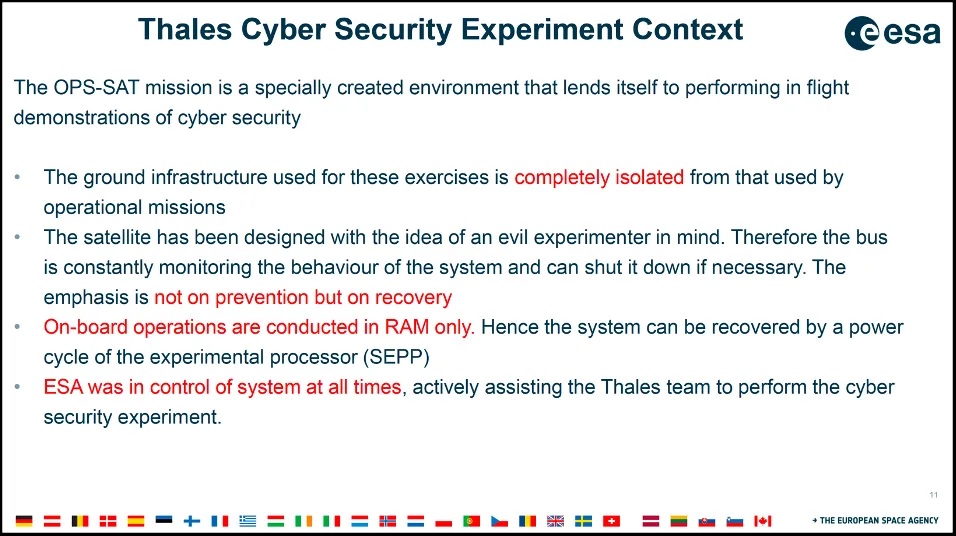
Figure 1: Thales Cyber Security Experiment Context (Slide courtesy The European Space Agency).

The results of the ethical satellite hacking exercise, the first of its kind in the world, will be used to tighten security for the satellite and its onboard applications, helping to improve the cyber resilience of space systems, protect sensitive data and support the long-term success of space programs.

To know more about the Thales Demo in video

What is OPS-SAT

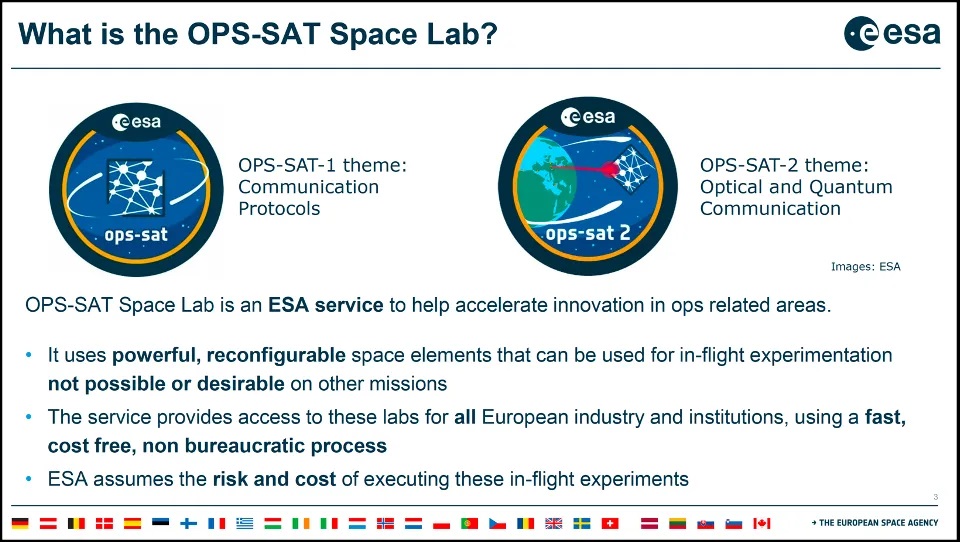
OPS-SAT is a small, CubeSat-class satellite developed by the European Space Agency (ESA) to serve as a testbed for innovative software, systems, and operational concepts in space.

From a cybersecurity perspective, OPS-SAT represents a critical platform for experimenting with and addressing the unique challenges of securing space-based assets.

Figure 2: What is the OPS-SAT Space Lab? (Slide courtesy The European Space Agency).

What is MITRE EMB3D™ Threat Model

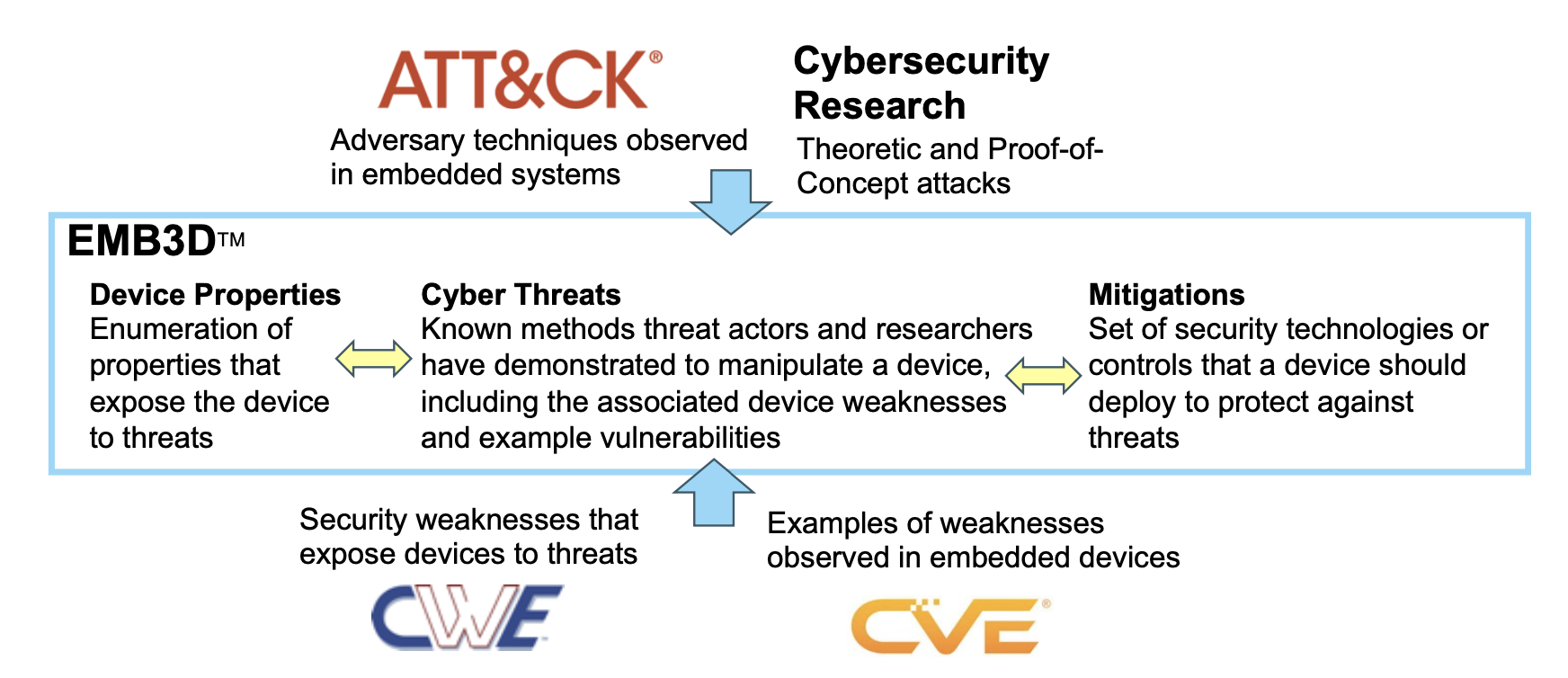
EMB3D™ is a Cybersecurity Threat Model released by MITRE in May 2024 and dedicated for Embedded Devices.

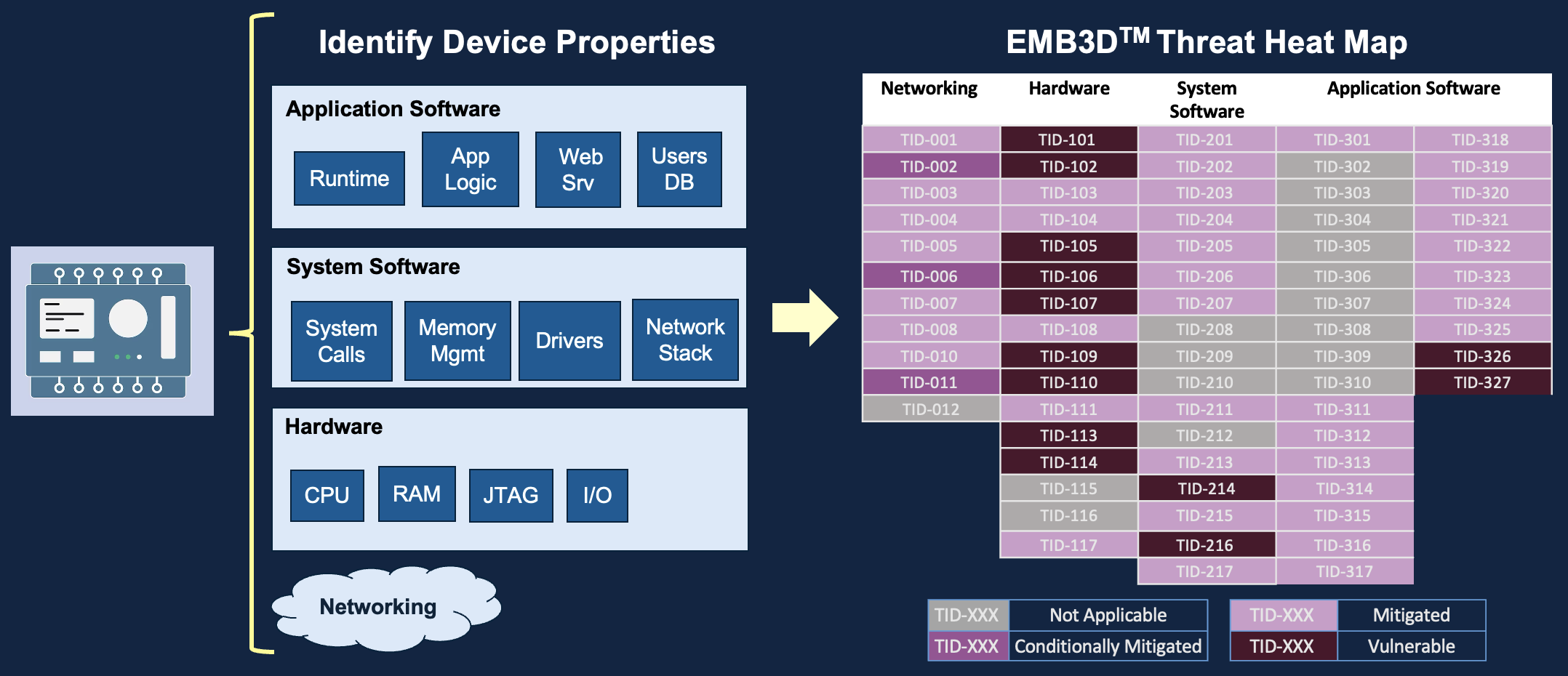
EMB3D is aligned with and expands on several existing models, including Common Weakness EnumerationMITRE ATT&CK®, and Common Vulnerabilities and Exposures, but with a specific embedded-device focus. The threats defined within EMB3D are based on observation of use by threat actors, proof-of-concept and theoretical/conceptual security research publications, and device vulnerability and weakness reports. These threats are mapped to device properties to help users develop and tailor accurate threat models for specific embedded devices.

Figure 3: The MITRE EMB3D™ Threat Model (figure courtesy The MITRE Corporation).

Each threat description include a set of Foundational, Intermediate, and Leading mitigations. These mitigations will provide guidance on what technical mechanisms can best prevent or reduce the risk of that threat.

For each threat, EMB3D will suggest technical mechanisms that vendors should build into the device to mitigate the given threat. EMB3D is a comprehensive framework for the entire security ecosystem—device vendors, asset owners, security researchers, and testing organizations.

To know more about the MITRE EMB3D™ Cybersecurity Threat Model for Embedded Devices, check our article here.

Analysis of the Thales OPS-SAT hacking Attack Chain

The figure below is showing a summary of the full attack flow used by the Thales team to conduct the attack on OPS-SAT.

Figure 4: Summary of the full attack flow (Slide courtesy Thales Group)

Step 1: Unsafe Java deserialization

To introduce the compromised or flawed software onto the spacecraft, the team needed to bypass security checks and evaluations. To achieve their objective, they introduced a deserialization vulnerability into the software, enabling defensive mechanism evasion and potential exploitation for executing arbitrary commands.

Figure 5: The Deserialization Vulnerability (Slide courtesy Thales Group)

The insecure deserialization threat is documented in the EMB3D Threat Model with the following Threat ID (TID) and Properties ID (PID):

Threat ID Properties ID
TID-326: Insecure Deserialization PID-3121: Device includes support for object oriented programming languages(e.g., Java, Python, PHP, C++)
Table 1: Identified threats for the step 1 (Unsafe Java deserialization)
Figure 6: Stay Undetected – Success! (Slide courtesy Thales Group)

Step 2: Applications Binaries Modified

Once the insecure deserialization achieved, the team uploaded a malicious code with the deserialization vulnerability to modify the application-level binaries on the remote device to introduce unauthorized code and to execute arbitrary commands on the remote system.

Figure 7: Stay Undetected – Execute Arbitrary Commands (Slide courtesy Thales Group)

The ability to modify application-level binaries and to install Untrusted Application on a remote system is documented in the EMB3D Threat Model with the following threats ID and properties ID:

Threat ID Properties ID
TID-301: Applications Binaries Modified PID-31: Application-level software is present and running on the device
TID-302: Install Untrusted Application PID-32: Device includes the ability to deploy custom or external programs (e.g., ladder logic, compiled binaries)
TID-307: Device Code Representations Inconsistent PID-324: Device includes support for « program uploads » to retrieve programs from the device from an engineering workstation
TID-308: Code Overwritten to Avoid Detection
TID-309: Device Exploits Engineering Workstation
Table 2: Identified threats for the step 2 (Applications Binaries Modified)

Step 3: Privilege escalation via the CAN bus

At this stage, their app runs as an unprivileged Linux user and has no direct access to sensors but though the supervisor. Their objective is now to find system configuration issues or vulnerabilities to realize a privilege escalation from user to root.

They identified that anyone can talk on the CAN bus, including unprivileged apps. And then, all commands send on the CAN bus are executing as root by a client that runs as root and that decodes and executes as root whatever command it receives.

Figure 8: Taking Control – Privilege Escalation from User to Root (Slide courtesy Thales Group)

The ability to privilege escalation is documented in the EMB3D Threat Model with the following threats ID and properties ID:

Threat ID Properties ID
TID-114: Peripheral Data Bus Interception
PID-13: Device includes peripheral chips and integrated data buses
TID-412: Network Routing Capability Abuse PID-42: Device includes procedure to forward or route network messages
TID-204: Untrusted Programs Can Access Privileged OS Functions PID-2321: Device lacks an access enforcement/privilege mechanism
TID-219: OS/Kernel Privilege Escalation PID-23221: Device includes and enforces OS user accounts
Table 3: Identified threats for the step 3 (Privilege escalation via the CAN Bus)
Figure 9: Taking Control – Arbitrary Code Execution as Root (Slide courtesy Thales Group)

Step 4: Persistence

At this stage, the app escalated as root. Now, the team needed to ensure persistent effects on sensors. They identified a jar library on the Supervisor that is writable by root user. A jar is simply a zip file, with compiled Java bytecode inside. The team crafted a bytecode based on the original one, and simply replace some files inside the jar. The supervisor now runs the jar containing the malicious bytecode.

Figure 10: Persistence – Injection of a Jar Library (Slide courtesy Thales Group)

The ability to manipulate Runtime Environment, to modify System Component and modify native library of the operating system are documented in the EMB3D Threat Model with the following threats ID and properties ID:

Threat ID Properties ID
TID-304: Manipulate Runtime Environment PID-322: Device includes a program runtime environment for custom or external programs
TID-305: Program Executes Dangerous System Calls PID-3231: Device includes ability to run custom/external programs as native binary without a confined/restricted environment
TID-203: Malicious OS Kernel Driver/Module Installable PID-231: Device includes an operating system that uses drivers/modules that can be loaded
TID-202: Exploitable System Network Stack Component PID-23: Device includes OS/kernel
TID-307: Device Code Representations Inconsistent PID-324: Device includes support for « program uploads » to retrieve programs from the device from an engineering workstation
TID-308: Code Overwritten to Avoid Detection
Table 4: Identified threats for the step 4 (Persistence)

Step 5: OPS-SAT attack by tampering with camera and ADCS

Once the team escalated as root and ensured persistency, they took control on the supervisor and the demo effects was achieved.

Figure 11: Demo Effects – Tampering with Camera & ADCS (Slide courtesy Thales Group)
  • They could alter/delete all images captured by the camera
  • They could override satellite attitude requested by other apps
  • This also provides persistence for the malicious code since the supervisor starts early and is almost always running
Figure 12: Other Potential Effects (Slide courtesy Thales Group)

Threat Heat Map

Using the EMB3D Threat Mapper feature, we create the following Threat Heat Map which represents all the threats affecting the system.

With the EMB3D Threat model, we identified  14 cyber threats. The data is shown into an Excel sheet.

Table 5: Threat Heat Map of the OPS-SAT system

Cyber risk mitigation for satellite system

The figure below shows the high-level countermeasures guidance provided by Thales.

Figure 13: Mitigation Risk – Prevention (Slide courtesy Thales Group)

The figure below shows the result of the analysis conducted by Brandon Bailey & Brad Roeher of the Thales experiment with the SPARTA framework (you can enter to the SPARTA portal here). In this figure, they are showing the full attack chain overlaid with SPARTA TTPs and associated countermeasures (full article of their analysis here).

Figure 14: The full attack chain overlaid with SPARTA TTPs and associated countermeasures. (Slide courtesy Thales Group and SPARTA Team)

In the rest of this article, I propose to identify a list of associated mitigations proposed by EMB3D Threat Model.


About Associated Mitigations in  the EMB3D Threat Model

In light of the various threats we have identified, we outline below a list of associated mitigations proposed by EMB3D Threat Model.

Mitigation tiers

These mitigations have varying efficiencies and challenges with their implementations.

Mitigation tiers (foundational/intermediate/leading) are intended to help better understand how to assess the challenge of deploying mitigations and better strategize and prioritize efforts to add additional mitigations or technologies to address threats.

Table 6: List of Mitigation Tiers in the MITRE EMB3D threat model

ISA/IEC 62443-4-2 Mappings

ISA is the International Society of Automation. ISA/IEC 62443 is the applicable standard for cybersecurity of OT and ICS (IACS). Each associated mitigation is mapped with the ISA/IEC 62443-4-2.

List of Associated Mitigations for the OPS-SAT

Step 1: Unsafe Java deserialization

Threats Associated Mitigations Level IEC 62443 4-2 Mappings
TID-326 – Insecure Deserialization
MID-077 – Secure Deserialization Foundational
  • CR 3.5 – Input validation
  • SAR / EDR / HDR / NDR 3.2 – Protection from malicious code
Table 7: Identified mitigations for the step 1 (Unsafe Java deserialization)

Step 2: Applications Binaries Modified

Threats Associated Mitigations Level IEC 62443 4-2 Mappings
TID-301 – Applications Binaries Modified MID-009 – Operating System-based Runtime Integrity Check Intermediate
  • CR 3.4 – Software and information integrity
MID-003 – Periodic/Continuous Integrity Measurement and Remote Attestation Leading
TID-302 – Install Untrusted Application MID-041 – Cryptographically Signed Vendor-supplied Programs Foundational
  • CR 3.4 – Software and information integrity
MID-051 – Disallow User-Provided Code Foundational
  • SAR / EDR / HDR / NDR 3.2 – Protection for malicious code
  • CR 3.4 – Software and information integrity
MID-040 – Cryptographically Signed Custom Programs Intermediate
MID-009 – Operating System-based Runtime Integrity Check Intermediate
  • CR 3.4 – Software and information integrity
MID-003 – Periodic/Continuous Integrity Measurement and Remote Attestation Leading
TID-307 – Device Code Representations Inconsistent MID-042 – Device Checks Consistency Between Binary/Running Code and Textual Code Foundational
  • CR 3.4 – Software and information integrity
TID-308 – Code Overwritten to Avoid Detection MID-017 – Security-relevant Auditing and Logging Foundational
  • CR 2.8 – Auditable events
  • CR 3.7 – Error handling
TID-309 – Device Exploits Engineering Workstation MID-008 – Decidable Protocols and Parsers Intermediate
  • none
Table 8: Identified mitigations for the step 2 (Applications Binaries Modified)

Step 3: Privilege escalation via the CAN bus

Threats Associated Mitigations Level IEC 62443 4-2 Mappings
TID-114 – Peripheral Data Bus Interception
MID-068 – Data Bus Encryption and Message Authentication Intermediate
  • CR 3.1 – Communication integrity – RE (1) Communication authentication
TID-412 – Network Routing Capability Abuse MID-017 – Security-relevant Auditing and Logging Foundational
  • CR 2.8 – Auditable events
  • CR 3.7 – Error handling
MID-038 – Authenticate for Administrative Actions Foundational
  • CR 2.1 – Authorization Enforcement
MID-083 – Network Firewall/Access Control List Foundational
  • CR 5.1 – Network segmentation
TID-204 – Untrusted Programs Can Access Privileged OS Functions MID-012 – OS-based Access Control Mechanisms Foundational
  • CR 2.1 – Authorization Enforcement
TID-219 – OS/Kernel Privilege Escalation
Table 9: Identified mitigations for the step 3 (Privilege escalation via the CAN bus)

Step 4: Persistence

Threats Associated Mitigations Level IEC 62443 4-2 Mappings
TID-304 – Manipulate Runtime Environment MID-013 – Process and Thread Memory Segmentation Foundational
  • SAR / EDR / HDR / NDR 3.2 – Protection from malicious code
MID-009 – Operating System-based Runtime Integrity Check Intermediate
  • CR 3.4 – Software and information integrity
MID-015 – Containerization Intermediate
  • SAR / EDR / HDR / NDR 3.2 – Protection from malicious code
  • CR 3.4 – Software and information integrity
TID-305 – Program Executes Dangerous System Calls MID-015 – Containerization Intermediate
  • SAR / EDR / HDR / NDR 3.2 – Protection from malicious code
  • CR 3.4 – Software and information integrity
TID-203 – Malicious OS Kernel Driver/Module Installable MID-009 – Operating System-based Runtime Integrity Check Intermediate
  • CR 3.4 – Software and information integrity
MID-003 – Periodic/Continuous Integrity Measurement and Remote Attestation Leading
TID-202 – Exploitable System Network Stack Component MID-007 – Control Flow Manipulation Protections Intermediate
  • SAR / EDR / HDR / NDR 3.2 – Protection from malicious code
MID-008 – Decidable Protocols and Parsers Intermediate
  • none
TID-307 – Device Code Representations Inconsistent MID-042 – Device Checks Consistency Between Binary/Running Code and Textual Code Foundational
  • CR 3.4 – Software and information integrity
TID-308 – Code Overwritten to Avoid Detection MID-017 – Security-relevant Auditing and Logging Foundational
  • CR 2.8 – Auditable events
  • CR 3.7 – Error handling
Table 10: Identified mitigations for the step 4 (Persistence)

The Advantages of the EMB3D Threat Model for a Satellite System

The EMB3D threat model enables the prioritization of mitigations through categorization into levels (fundamental, intermediate, advanced). This allows for a gradual implementation.

The EMB3D threat model is aligned with standards. The mitigations are mapped to the security controls specified in the ISA/IEC 62443-4-2 standard for industrial control systems.

The EMB3D threat model is complementary to the SPARTA framework. It helps propose additional mitigations, allowing to create a consolidated list of security measures.

Next steps to go further

After identifying the mitigations and countermeasures proposed by the EMB3D threat model, here are the next steps you can take.

The next step in the study will be to verify if the countermeasures proposed by the EMB3D threat model can be embedded on the OPS-SAT system and can effectively prevent all the actions carried out by the team.

The next step can be also to develop an implementation plan and a roadmap to implement the selected mitigations, considering technical and operational constraints.

We could also do a comparative analysis by comparing the mitigations proposed by the EMB3D threat model and the SPARTA framework to check their relevance and to identify overlaps and differences. This will allow to create a consolidated list of security measures.

Acknowledgments

Many thanks to ESA, to the CYSAT conference and to the Thales team for making this experiment possible, and for making it so enriching for the community.

A big thank you also to the SPARTA team, who inspired this article and contribute to strengthening the cybersecurity of satellites and space systems.

Derniers articles

MITRE ESTM + EMB3D in Action : Analyzing OPS-SAT Through These Dual Frameworks

0
Disclaimer Please be informed that the analysis detailed in this article is entirely separate from the hacking experiment conducted by the Thales team on the...

Exploring how the new MITRE ESTM (Embedded Systems Threat Matrix) can work in conjunction...

0
Recently, MITRE released ESTM (Embedded Systems Threat Matrix), a new cybersecurity framework designed to protect embedded systems. Built on the proven ATT&CK® methodology, ESTM...

SPARTA v3.2: Raising the Bar for Threat‑Informed Space Cybersecurity

0
The Aerospace Corporation has released SPARTA v3.2, further strengthening its role as a practical, threat‑informed framework for securing modern space missions against sophisticated cyberattacks. This...

Introducing the new MITRE Embedded Systems Threat Matrix (ESTM)

0
Embedded systems have become the unsung heroes of modern technology. They power our satellites, medical devices, vehicles, and industrial infrastructures, quietly operating at the...

Mapping the Thales Satellite Hacking Demo using SPARTA TTPs and PWNSAT ATT&CK Flow Builder...

0
In 2023, during the CYSAT conference, Thales presented a live demonstration of a satellite hacking scenario, a milestone event that shed light on the...

Articles les plus lus

Cartographie des acteurs étatiques du cyber en France

0
Avec l'aimable autorisation de Martial Le Guédard, nous reproduisons ci-dessous sa cartographie au sujet des différents acteurs étatiques évoluant dans le domaine du Cyber...

Cartographie des services spécialisés de la communauté du renseignement (1er et 2ème cercle)

0
L'illustration ci-dessous est une carte heuristique qui présente les services spécialisés de la communauté du renseignement du 1er cercle. Cette cartographie est mise à...

Qu’est-ce que le grand Commandement De l’Espace (CDE) créé par la France pour la...

2
Le Commandement De l’Espace (CDE) a été créé par arrêté le 3 septembre 2019. Il succède au Commandement interarmées de l’espace (CIE). Il rassemble...

An analysis of the Viasat cyber attack with the MITRE ATT&CK® framework

2
Disclaimer To do this analysis of the Viasat cyber attack, I used the open-source intelligence (1) of the team composed by Nicolò Boschetti (Cornell University),...

Cartographie des acteurs français et européens de la cybersécurité satellitaire et spatiale

1
La France est leader de la politique spatiale en Europe. Elle met en oeuvre des projets innovants et performants avec en permanence de nouveaux...

Popular posts

Cartographie des acteurs étatiques du cyber en France

0
Avec l'aimable autorisation de Martial Le Guédard, nous reproduisons ci-dessous sa cartographie au sujet des différents acteurs étatiques évoluant dans le domaine du Cyber...

Cartographie des services spécialisés de la communauté du renseignement (1er et 2ème cercle)

0
L'illustration ci-dessous est une carte heuristique qui présente les services spécialisés de la communauté du renseignement du 1er cercle. Cette cartographie est mise à...

Qu’est-ce que le grand Commandement De l’Espace (CDE) créé par la France pour la...

2
Le Commandement De l’Espace (CDE) a été créé par arrêté le 3 septembre 2019. Il succède au Commandement interarmées de l’espace (CIE). Il rassemble...

An analysis of the Viasat cyber attack with the MITRE ATT&CK® framework

2
Disclaimer To do this analysis of the Viasat cyber attack, I used the open-source intelligence (1) of the team composed by Nicolò Boschetti (Cornell University),...

Cartographie des acteurs français et européens de la cybersécurité satellitaire et spatiale

1
La France est leader de la politique spatiale en Europe. Elle met en oeuvre des projets innovants et performants avec en permanence de nouveaux...